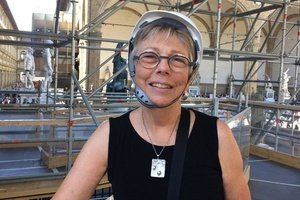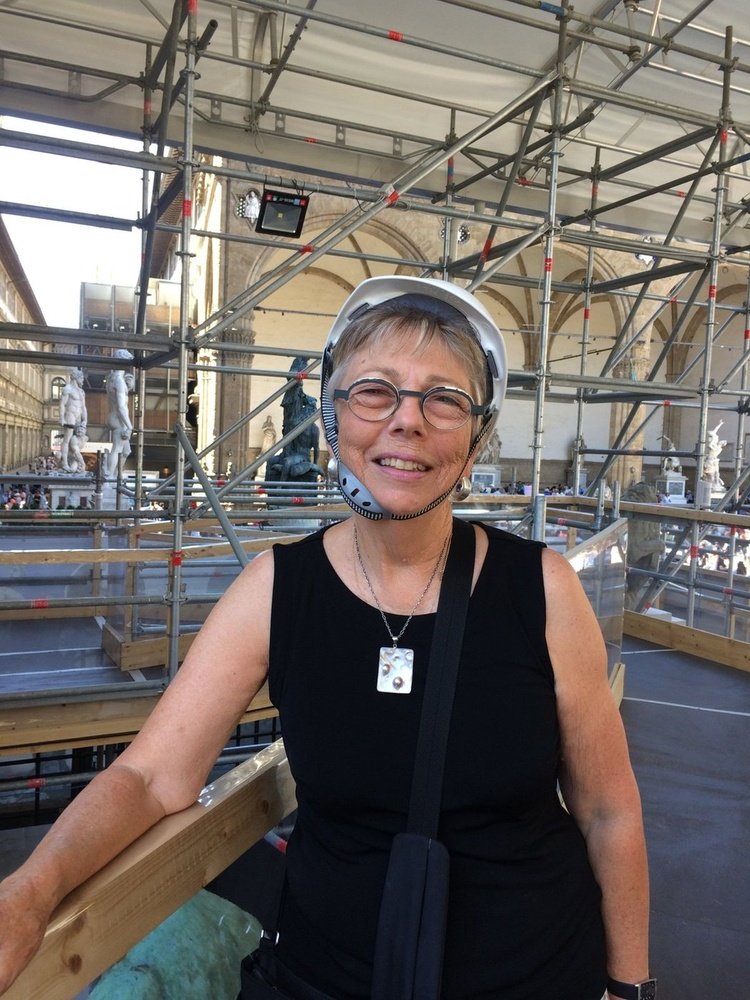
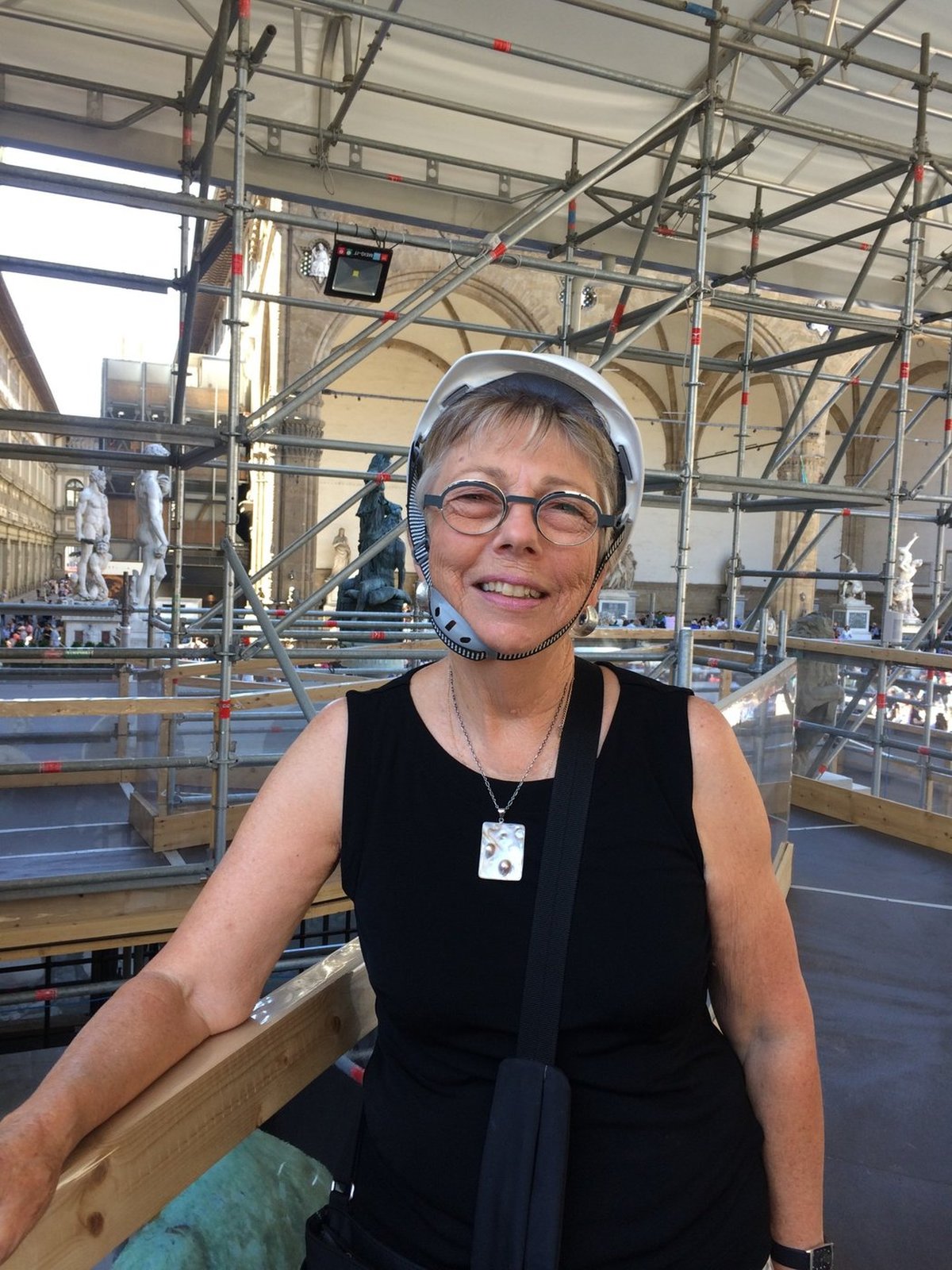
The work is the result of extensive research and grew out of the passion and dedication of a woman who went to Florence to study Italian, fell in love with the city and spent more than a decade immersing herself in the many aspects of its history through images and documents.
It is not a traditional art history. Although some of the works discussed are masterpieces by celebrated sculptors, this is not the book’s main focus. By studying these sculptures, the author instead explores myth, faith and beliefs, the creativity of artists, power and its influence on art and, above all, the tenacity with which humanity and art have endured, in times of peace as well as turmoil. The 20 essays that make up the 390-page volume take the reader from legendary Troy, through the Renaissance, to the present day. A publication that once again shows Australians’ interest in Italy.
It all began at the Bargello Museum during her first trip. “As I stood before Vincenzo de’ Rossi’s Dying Adonis, I found myself leaning forward, as if to comfort him by taking his hand,” Hall recalls. “Don’t touch, Di! The guards will throw us out,” warned a casual acquaintance who was with her that day. “Of course I didn’t touch him, but at that moment the sculpture came to life.” Shortly afterwards, two other figures captivated her: Thusnelda, a seemingly solitary marble woman in the Loggia dei Lanzi, and Doris, a bronze sea goddess on the Fountain of Neptune. “As with new friendships, I wanted to know more about them: it was a fascination that kept growing.”
This is also where the book’s title comes from. “The soul of Florence is a tapestry: pull one thread and many others come loose,” the author explains. To avoid feeling completely overwhelmed, she needed a focal point, a “lens” through which to look. More than the usual Medici and mythological heroes, it was the female sculptures that struck her, so different from one another that each seemed to open an entirely different door to the past. “Women hold the details,” she observes, “and little by little I realised that statues are anything but inert monuments: they are silent witnesses to their own stories and those of others.”
It was a vast and complex project, lasting more than ten years. “Few people in their right mind would choose such an endless undertaking. Sometimes I think it was these sculpted women who chose me,” she admits. At first, she had no intention of writing a book: the research, with its discoveries and the ideas it offered, was reward enough. But without putting knowledge into writing, the mind cannot retain such complex and conflicting information. So she began writing an essay on each sculpture, and only later decided that her sculpted women deserved a home of their own: a book in its own right, illustrated with more than 200 images.
Each essay is devoted to a sculpture and traces the worlds surrounding it. Through figures such as Medusa, Niobe and the Sabine women, the book shows how classical myths have been interpreted and reinterpreted for artistic, religious and political purposes, distorting women’s stories over time. Elsewhere, the reality of Florentine society emerges through the nuns and saints of convents, images of the Annunciation and funerary monuments. The story of a grieving husband brings the risks of childbirth in the Renaissance into focus, while Donatello’s Penitent Magdalene offers glimpses of plague, poverty, devotion and fear of the afterlife.
Another strand concerns the physical survival of statues during periods of upheaval. During World War II, Michelangelo’s sculptures from San Lorenzo, moved to the Tuscan countryside, found themselves in the line of fire. “Almost no one thinks about it when entering the tranquillity of the New Sacristy,” Hall notes. And few imagine the Ponte Santa Trinita being blown up in 1944, with its statues of the seasons lying shattered all around.
Even a little-known statue, then, can hold a hidden human story. Such is the case of Doris, the subject of one of the first essays. Her myth amounts to little more than being one of many sisters and having 50 daughters, but from her place in Florence she witnessed the true, forgotten story of Joanna of Austria, a Habsburg princess who married a Medici and vanished from history almost before she died, and the events behind the fountain’s construction. “Spending time with every sculpture that caught my eye, whether famous or little known, revealed layers of interconnected stories and uncovered secrets,” Hall says.
For those who have never been to Florence, the author hopes the book will foster an appreciation of “her” city and perhaps a desire to visit it. But the message goes further: any city can be understood much more deeply by unravelling the threads of the stories hidden behind its art. “To see sculpture only as artistic genius or decoration is to miss the human experiences it holds: from pain to physical toil, from the traumas of war to quiet triumphs,” she concludes. “History is not locked behind a glass display case: if you approach quietly and listen carefully, the past still speaks, and what it reveals still has much to teach the present.”