On 8 March, in front of 483,934 people at Albert Park, a 19-year-old Italian finished second at the Australian Grand Prix. George Russell won it for Mercedes; Kimi Antonelli, his teammate, crossed the line 2.974 seconds later, with Charles Leclerc third. Most of the crowd had come to watch Oscar Piastri.
A week later, in China, Antonelli won his first grand prix — the first Italian to win any race since Giancarlo Fisichella in Malaysia in 2006, five months before Antonelli was born. In September he won at Monza from 19th on the grid, the first Italian to win his home race since Ludovico Scarfiotti in 1966. On 1 November in Mexico City he finished third, which was all he needed: at 20 years and 68 days he became the youngest world champion in the sport’s history, and Italy’s first in 73 years.
Google Trends data tracks how that year looked from Australia.
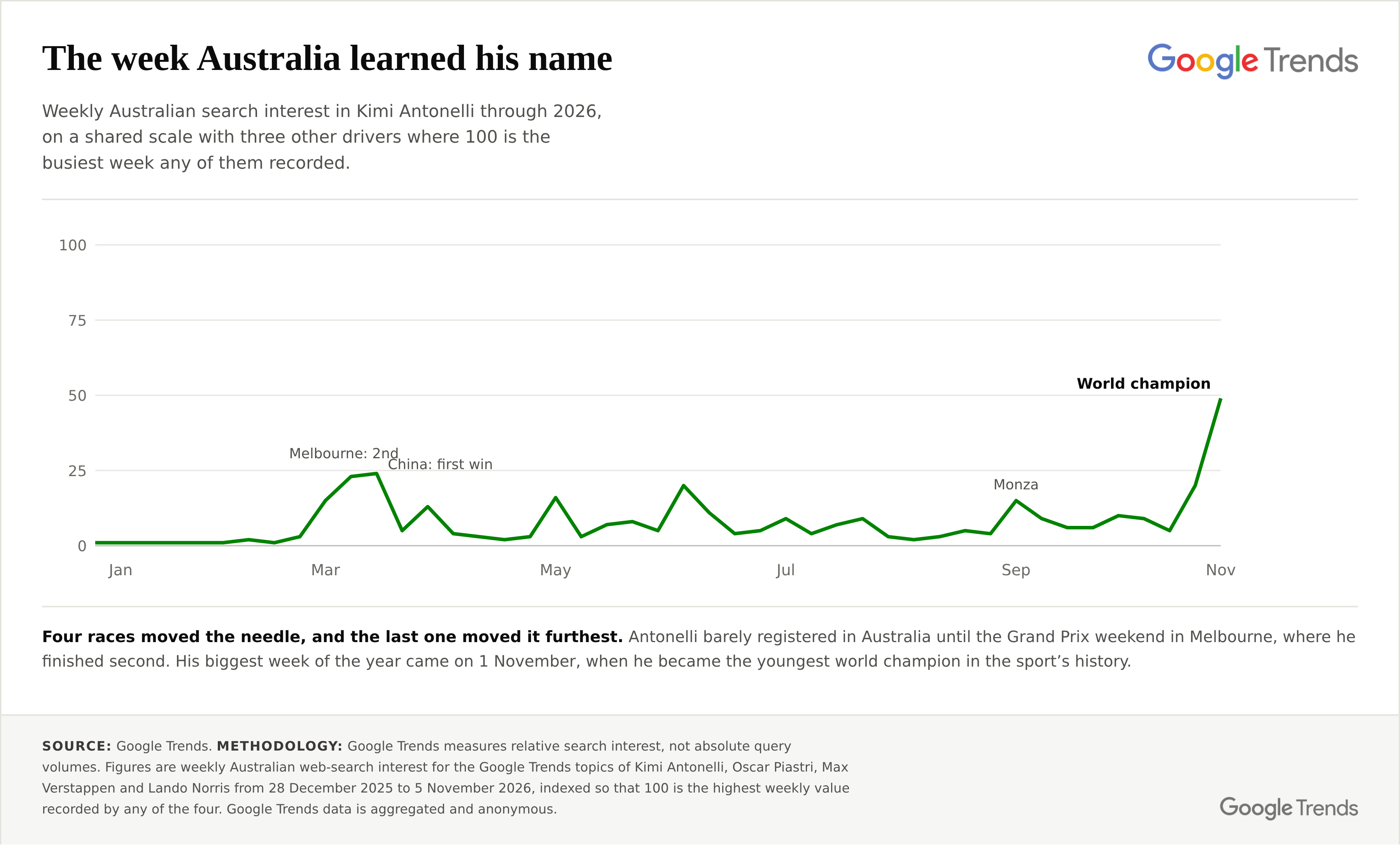
Four races that moved the needle
For the first two months of the season Antonelli barely registered in Australian searches. The Melbourne weekend changed that, and his first win in China the following week held the interest. Then came a long middle stretch where he rose and fell with the calendar, before the title week took him past anything he had recorded before.
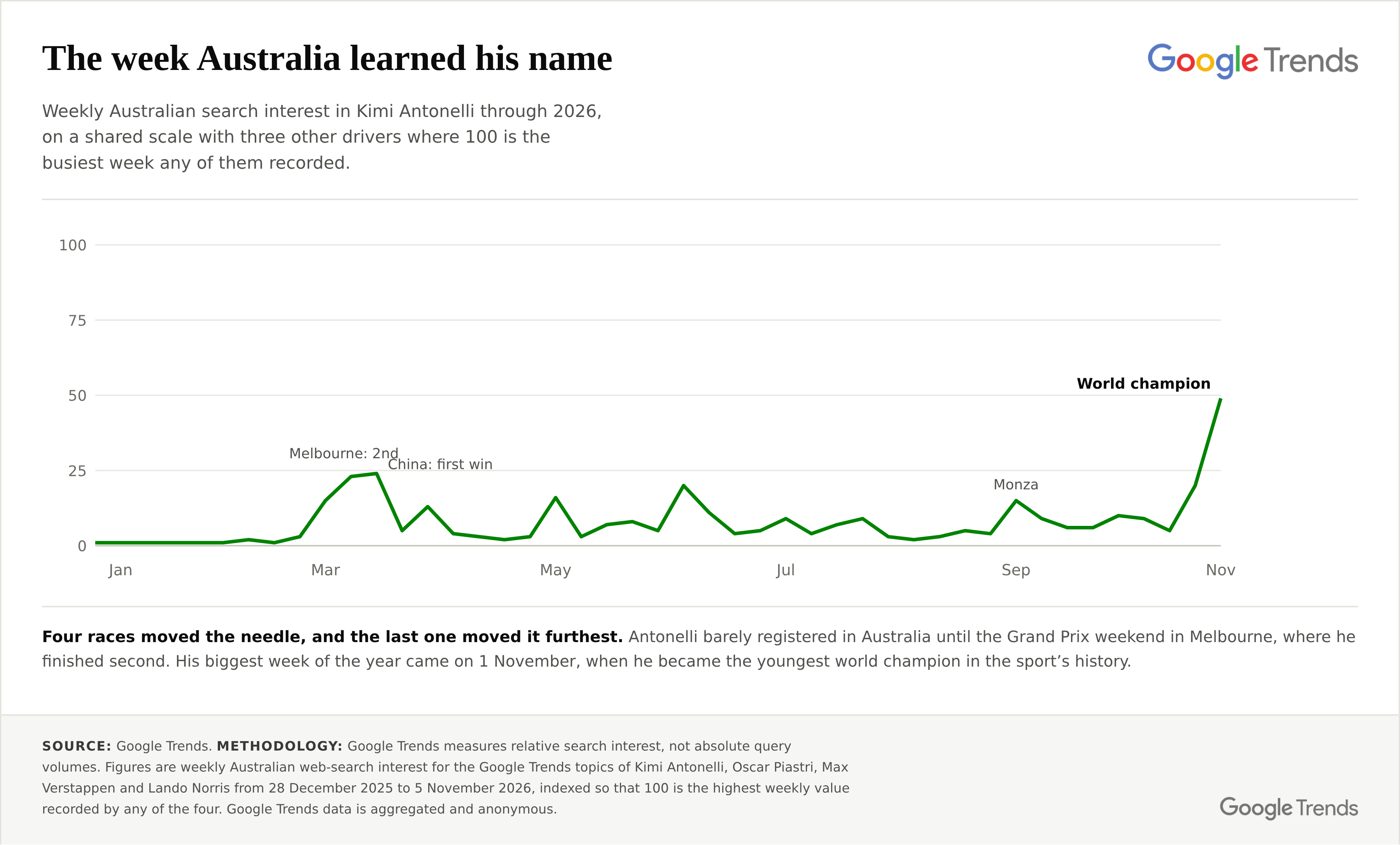
Figure 1: Weekly Australian search interest in Kimi Antonelli through 2026. Source: Google Trends.
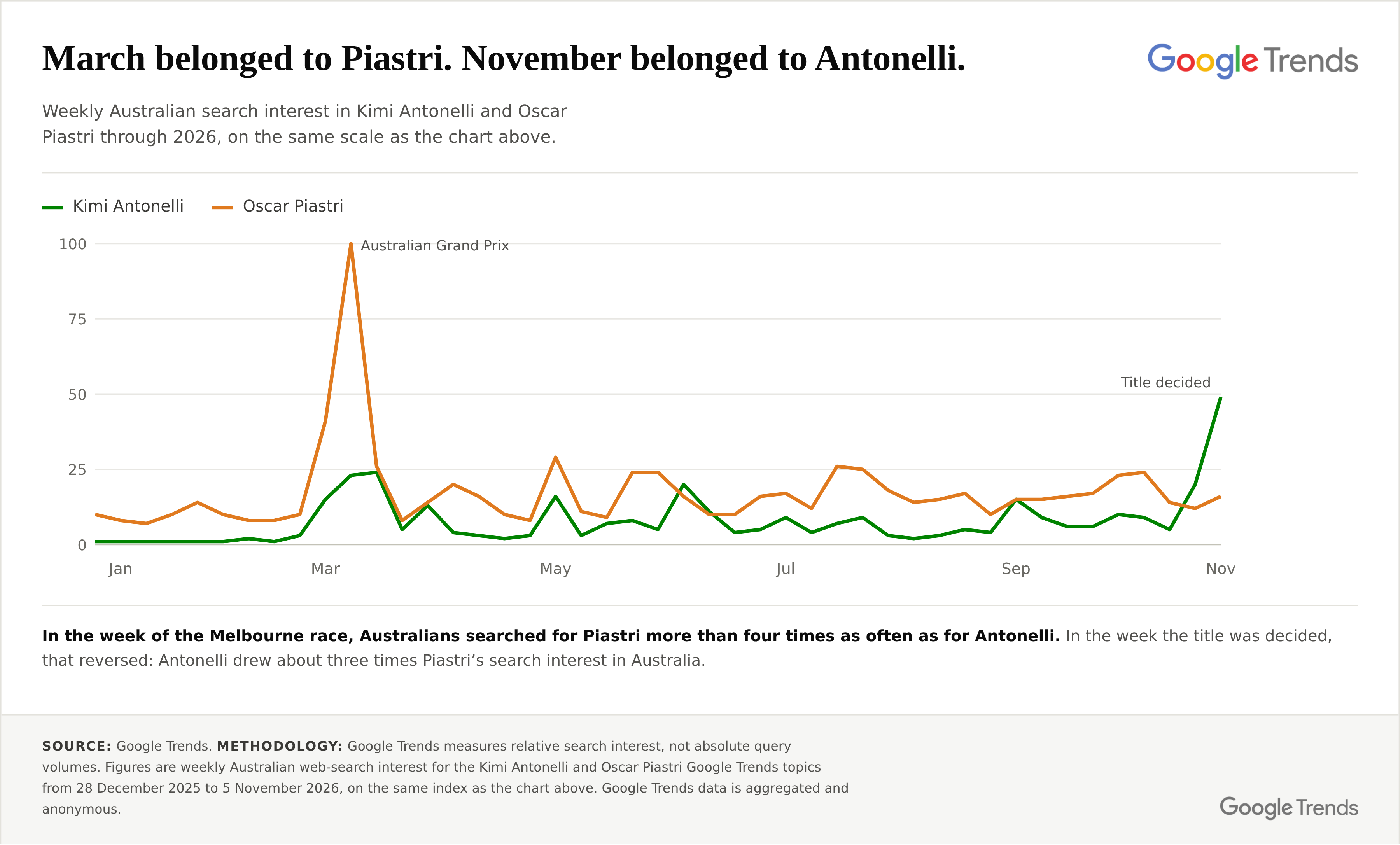
March belonged to Piastri
The comparison with Australia’s own driver is the sharpest way to see it. In the week of the Melbourne race, Australians searched for Piastri more than four times as often as for Antonelli. Piastri’s spike that week is the highest point in the whole series.
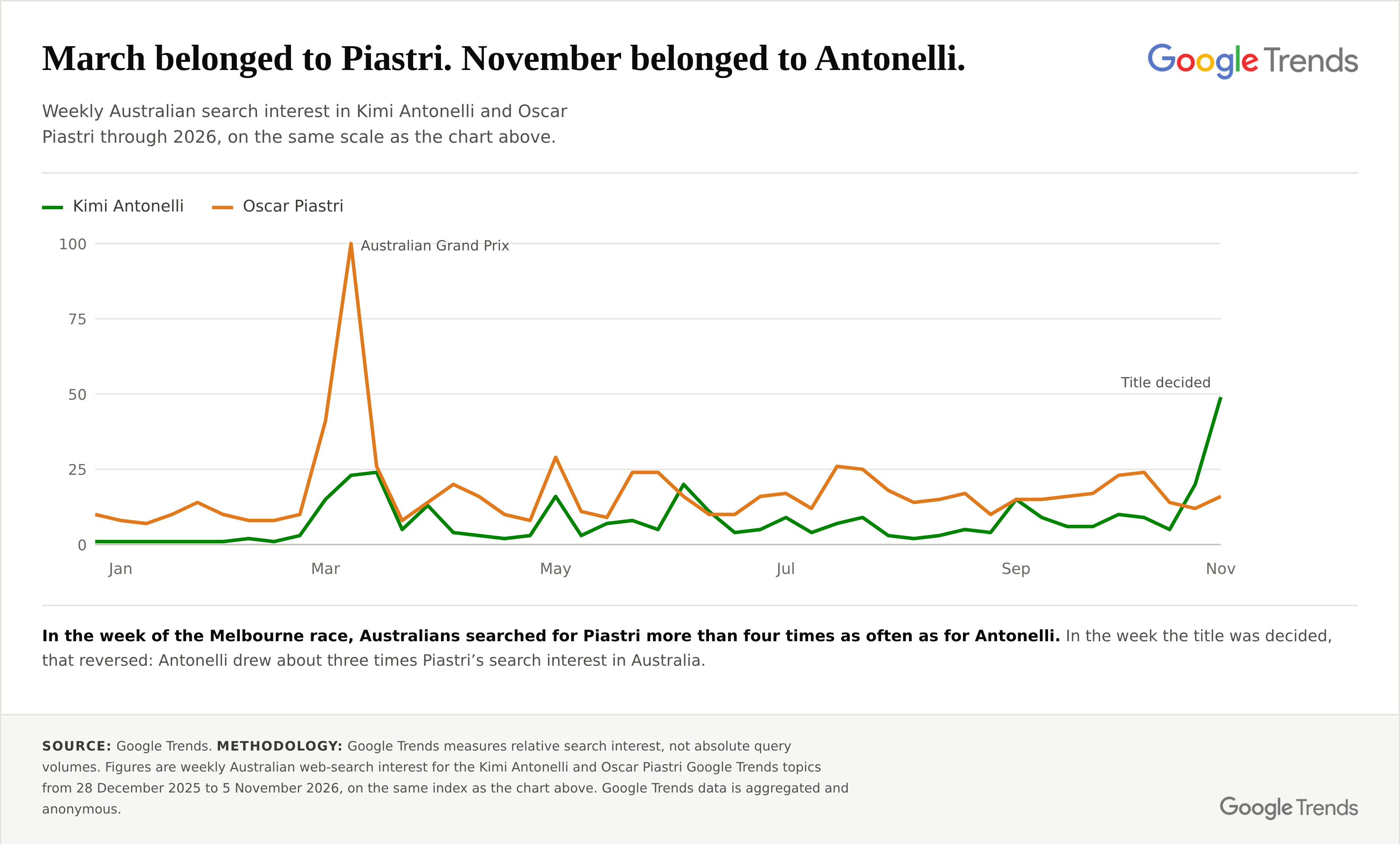
Figure 2: Weekly Australian search interest in Kimi Antonelli and Oscar Piastri through 2026. Source: Google Trends.
In the week the championship was decided, it reversed. Antonelli drew about three times Piastri’s Australian search interest — the only week all year in which he clearly led.
What Australians wanted to know
The questions were the ones you would expect of a driver most people had just met. “Youngest f1 champion”, “how old is kimi antonelli” and “kimi antonelli world champion” were among the fastest-rising searches in Australia over the past year. One of the odder risers was for the sale of an Antonelli trading card for US$200,000.
There is also a telling contrast with the team most Australians associate with Italian motorsport. In the title week, Antonelli drew about twenty times the Australian search interest of Scuderia Ferrari, whose searches have been flat for a decade. The Italian story in Australian search is now a driver, not a marque.
Where in Australia
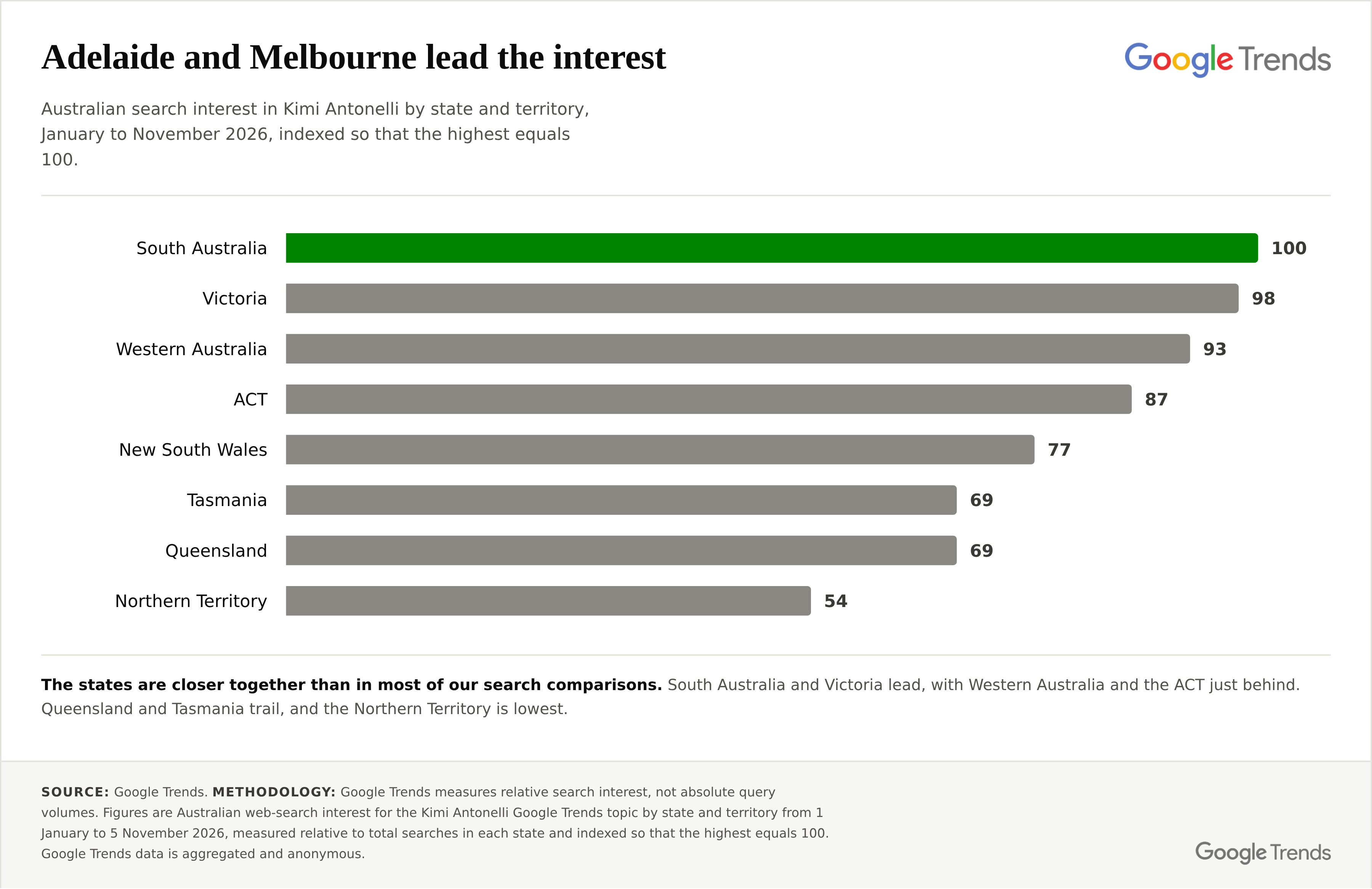
Interest is spread more evenly across the country than in most search comparisons. South Australia and Victoria lead, with Western Australia and the ACT close behind.
Figure 3: Australian search interest in Kimi Antonelli by state and territory, January to November 2026. Source: Google Trends.
Australia in the world
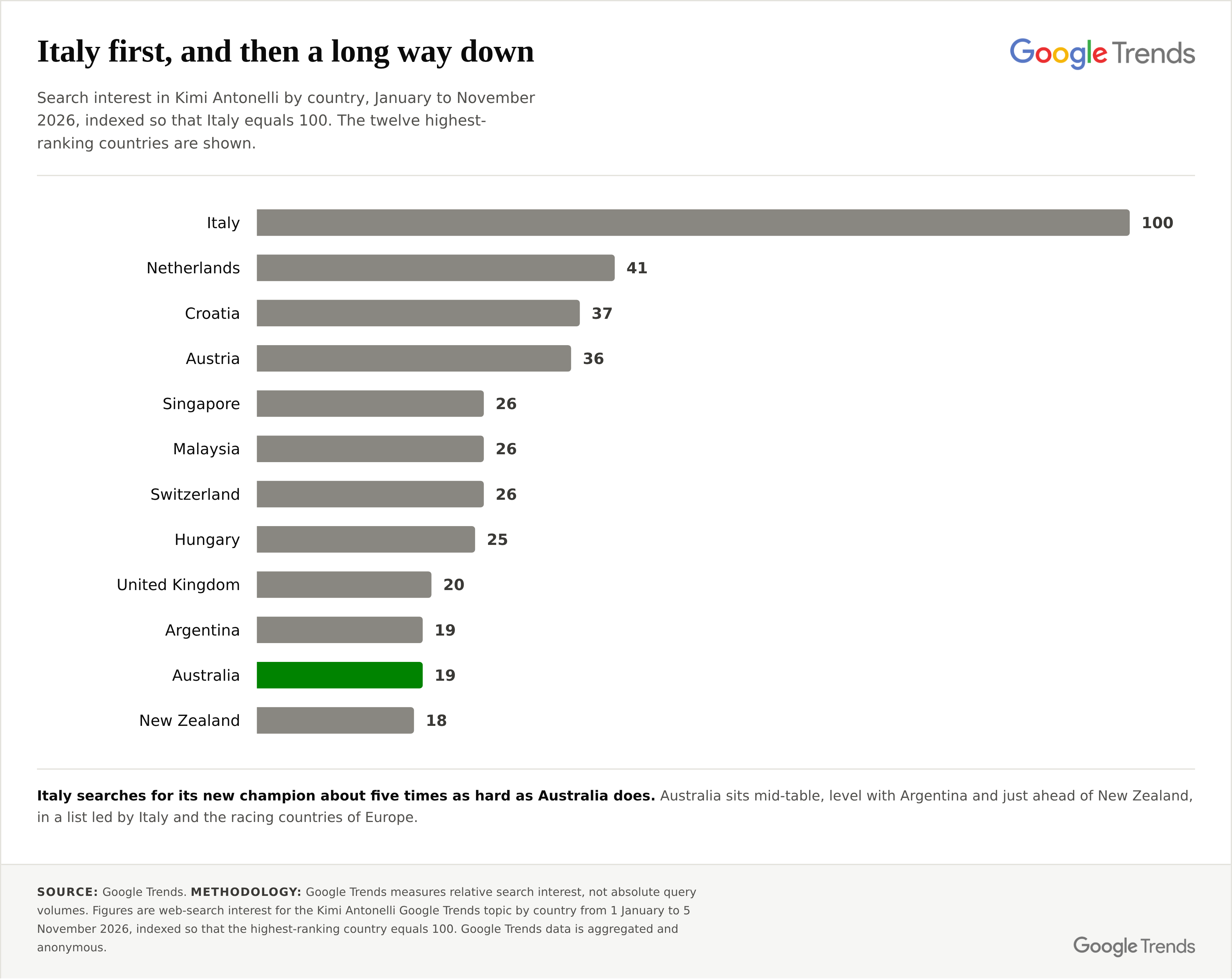
Seen globally, Australia is a modest part of the audience. Italy searches for its new champion about five times as hard as Australia does, and the Netherlands, Croatia and Austria all rank higher. Australia sits level with Argentina and just ahead of New Zealand.
Figure 4: Search interest in Kimi Antonelli by country, January to November 2026. Source: Google Trends.
Back to Albert Park
The Australian Grand Prix opens the season again in March. Antonelli will return to the circuit where he was beaten by three seconds, this time as world champion, and the search data suggests Australians will know who he is before the lights go out.
About the data
Figures are from Google Trends for Australia and were collected on 6 November 2026. Google Trends measures relative search interest on a 0–100 scale rather than absolute search volumes, so numbers can only be compared within the same chart. Drivers are measured as Google Trends topics, which group related searches together, and were compared on one shared scale. Weekly figures run from 28 December 2025 to 5 November 2026. Race results, crowd figures and records are from Formula 1, ESPN, Sky Sports and the Australian Grand Prix race report. Google Trends data is aggregated and anonymous.