MELBOURNE - Architecture should not be confined to the design of buildings. Instead, it should be understood as a tool for interpreting communities and telling the story of cultural and social change.
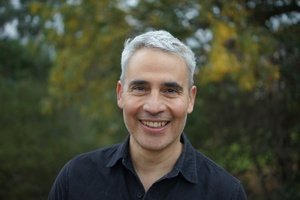
That is the vision of Guillermo Aranda-Mena, architect, researcher and lecturer at RMIT University, who has spent more than a decade collaborating with the Politecnico di Milano and the UNESCO Chair in Mantua. His career has been defined by exploration, shaped by a life lived across different continents and cultures that has profoundly influenced both his professional approach and his worldview.
Born in Mexico City and raised in Guadalajara, Aranda-Mena has built an international career that has taken him across Europe, Asia and Australia, where he has lived for the past 22 years.
“For more than fifteen years I collaborated with the Politecnico di Milano through a UNESCO Chair,” he said, helping educate students from around the world through an international master's program taught in English. He spent a year living in the Milan area and still returns to Italy regularly, at least once a year.
“My main area of interest is the built environment,” Aranda-Mena explained. “I focus on designing sustainable environments, not only from an environmental perspective but also from a social and economic one.”
It is a philosophy that sees architecture as something capable of profoundly influencing people's lives.
“I’m interested in understanding how spaces can transform communities and contribute to the cultural growth of places,” he said. In this sense, architecture extends far beyond the construction of buildings, creating connections between people, memory and identity, while serving as “a record of a country’s historical and social evolution”.
This approach is on display at Gasworks Arts Park in Albert Park through Buildscape: Evocations of Place, Space and (E)motion, a solo exhibition that opened last Saturday and runs free of charge until June 28.
Through abstract landscapes painted in acrylic on handmade bark paper, large-scale tapestries and three-dimensional models, Aranda-Mena explores the relationship between space, emotion and movement. The exhibition unfolds in a series of interconnected sections that reflect different stages of his personal and professional journey.
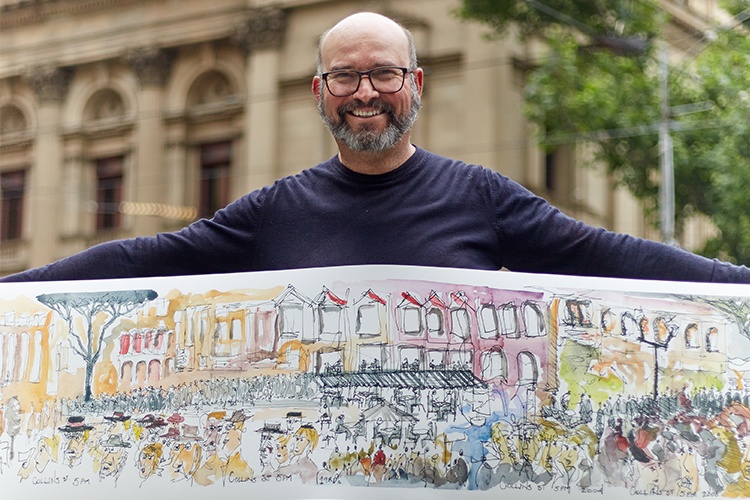
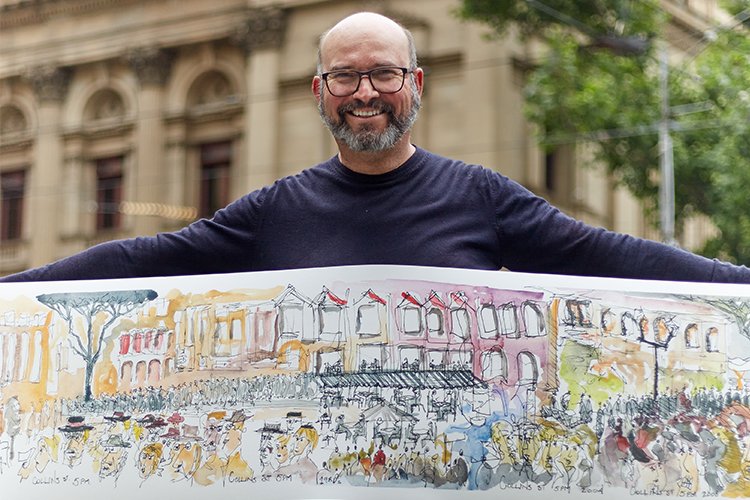
A significant portion of the exhibition is dedicated to Melbourne, featuring drawings and sketches of the city’s urban landscape, including Bourke Street, Collins Street and the St Kilda foreshore with its iconic Route 96 tram.
There is also a section devoted to his native Mexico, showcasing three-dimensional volumetric studies of architectural forms highlighted by “the vibrant colours traditionally used in Mexico, derived from pigments made from flowers and plants”. The works draw on the artistic traditions of his homeland and reflect a deep connection to nature.
Alongside this exhibition, Aranda-Mena is presenting a second show from June 10 to 12 at Level 1 of the Melbourne Convention and Exhibition Centre as part of the World Sustainable Built Environment Conference 2026, where he serves on both the organising and scientific committees.
In this exhibition, travel takes centre stage. Through a visual diary composed of watercolour works, Aranda-Mena traces the cities that have shaped both his life and professional career.
The concept recalls an exhibition he created for his 50th birthday, in which each painting represented a year of his life, from 1973 to 2023. Together, the works revisited childhood memories, study trips, professional experiences and personal encounters that helped define who he is today.
It is an identity, he says, that can no longer be reduced to a single nationality.
“When you live in many different places, you learn that your identity is not defined by nationality,” Aranda-Mena reflected. “It is defined by your gravitas: the collection of values, experiences, friendships and memories that guide your life.”