Artificial Intelligence has been used for the first time to reconstruct the last moments of a Pompeii man trying to flee the wrath of Vesuvius in the 79 AD eruption that destroyed and preserved the ancient Roman city. Pliny the Younger’s tales of the event the historian witnessed have been revisited with artificial intelligence in a digital reconstruction of the past that meets the future.
For the first time, the Pompeii Archaeological Park has used AI tools to propose, in collaboration with the University of Padua, a digital reconstruction based on investigations conducted by archaeologists from the Ministry of Culture.
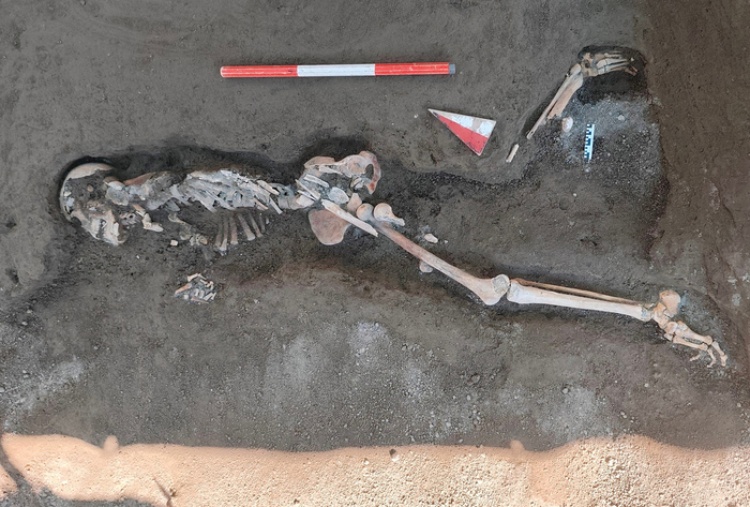
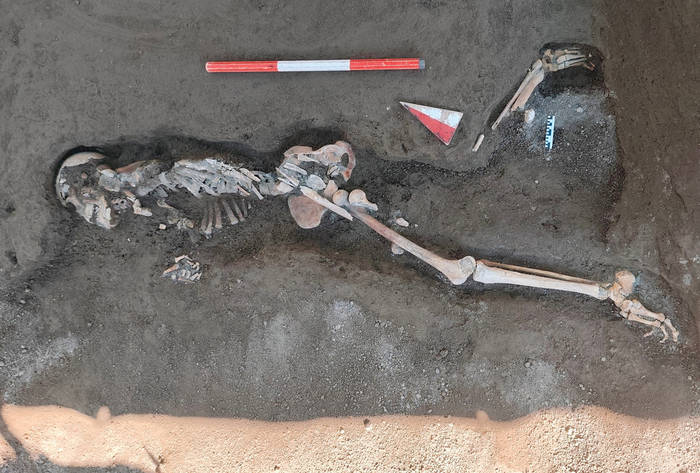
The reconstruction concerns a man who died during the eruption of Vesuvius and was found with a terracotta mortar, likely used to protect his head from falling lapilli and volcanic fragments.
It’s all based on the descriptions of Pliny the Younger, an eyewitness, who in a letter reported how people fleeing the volcano tried to protect themselves from the eruption with objects or pillows tied to their heads.
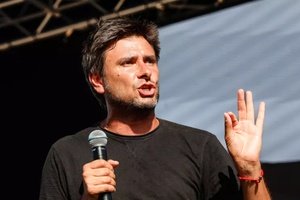
“Pompeii is perhaps the most prestigious site in the world for archaeological research,” emphasized the Minister of Culture, Alessandro Giuli, “where each new discovery excitingly illuminates the fabric of ancient life.
“The investigations conducted with these excavations demonstrate that innovative methodologies, used rigorously, can give us new historical perspectives.” The discovery was made during recent excavations in the area of the Porta Stabia necropolis, just outside the walls of ancient Pompeii.
Archaeologists working in the field uncovered the remains of two men fleeing toward the coast during the eruption. One of them, the younger, was likely engulfed by a fiery cloud of ash and toxic gases. The other, an older man, died a few hours earlier under a heavy shower of lapilli, trying to protect his head with a terracotta mortar found next to his body.
He also carried a ceramic lamp to help him navigate in poor visibility, a small iron ring on his left little finger, and a hoard of ten bronze coins.
The digital model, which offers a reconstruction of the second victim, was generated through a combination of artificial intelligence and photo editing techniques, with the goal of providing a scientifically sound yet accessible image, making the results of archaeological research accessible to a non-specialist audience.
“The vastness of archaeological data at Pompeii is now such that only with the help of artificial intelligence will we be able to protect and enhance it,” explains Park Director Gabriel Zuchtriegel.
“And it’s important that we archaeologists take charge of it ourselves, because otherwise others will do it in our place, lacking the necessary humanistic and scientific background.
“The project opens a broader discussion on the use of AI in archaeology,” adds Professor Jacopo Bonetto of the University of Padua, “a technology that can contribute to improving communication tools.” “Two thousand years later,” explains Professor Luciano Floridi, founding director of the Digital Ethics Center at Yale, “AI is helping us reconstruct the final moments of Pompeii.
Artificial intelligence does not replace archaeologists. Under its control, it expands their potential and makes accessible to many what was previously only accessible to a few.”
ANSA