While many customs carried out during the festive season have their roots in religion, others are rather peculiar and may come as a surprise.
Discover these five traditions that complete Christmas in Italy.
Elaborate nativity scenes
While Christmas nativity scenes are popular in many parts of the world, they take on a whole other meaning in Italy.
Known in Italian as presepi, nativity scenes often depict the entire town of Bethlehem in painstaking detail and can be found in every church as well as other public areas and family homes from December 8.
Sometimes there is a modern twist with contemporary characters introduced, such as famous footballers or politicians.
The most important detail is of course the crib in the manger, which remains empty until Baby Jesus makes his entrance and is finally placed in the crib on Christmas Eve, completing the scene.
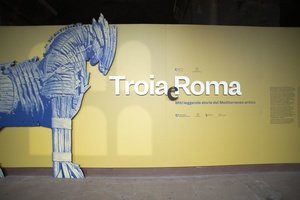
In Rome, an annual exhibition displays 100 different presepi from all over the world, including miniscule versions carved into nuts and all kinds of materials – even pasta.
But Naples takes the title of the true home of the presepe: Via San Gregorio Armeno in the city’s historic centre is sometimes called Christmas Alley as its shops all sell figures for the cribs, from the wacky to the traditional.
Although they are open all year round, the best time to visit is during the months of September or October, before the busy Christmas season, just at the time when the artisans are preparing their shops for Christmas.
You can even witness these skilled craftsmen actually work on the figures as they carve and paint them.
Naples is also home to the Museo Nazionale di San Martino, which houses what is considered to be the largest nativity scene in the world.
The Presepe Cucinello features 160 characters, 80 animals, 28 angels and over 400 miniature objects!

A view of Via San Gregorio Armeno in Naples. (Photo: iStock)
A visit from La Befana
Like children all around the world, kids in Italy also look forward to the arrival of the red-suited Santa Claus on Christmas Eve.
However, this relatively modern tradition pales in comparison to the anticipation generated by the arrival of an old witch in early January.
The witch, known as La Befana, has been around in Italy since as early as the eighth century.
According to legend, the Three Wise Men happened upon La Befana, a witch-like woman riding on a broom, early on during their quest.
She charitably hosted them for an evening in her humble but cosy cottage; the next morning, they invited her to accompany them to Bethlehem.
Busy with her housework, La Befana declined at first – but then, after they carried on their way, she had second thoughts.
She quickly filled a basket with gifts for Baby Jesus and set off alone.
Although she followed the same star, she was unable to find the manger before the Three Wise Men did.
Today, the tattered and soot-covered Befana continues to travel the world on Epiphany Eve, searching every house for the child and leaving sweets and chocolates for the good children in her wake.
For those who have fallen a bit short of model behaviour, La Befana leaves lumps of coal, garlic and onions.
Knowing that all kids can’t be perfect all year round, some shops in Italy sell carbone, or black rock lollies that actually look like pieces of coal… so even those not as well behaved can still enjoy a sweet treat.

La Befana. (Photo: Pixabay)
No meat on Christmas Eve
In a tradition that has its roots in religion, many Italians refrain from eating meat on Christmas Eve.
Known in Italian as la Vigilia, December 24 was traditionally a day of fasting before Christmas for Catholics, with festivities starting only after the evening mass.
This is still observed in some families, and the evening meal is usually based on seafood rather than meat.
Different products from the ocean are served as appetisers or with pasta.
Clams and oysters are often used as they are seen as luxurious.

Linguine with clams. (Photo: iStock)
Sweetening the festive season with panettone or pandoro
At Christmas, the Italians are especially big on sweet treats.
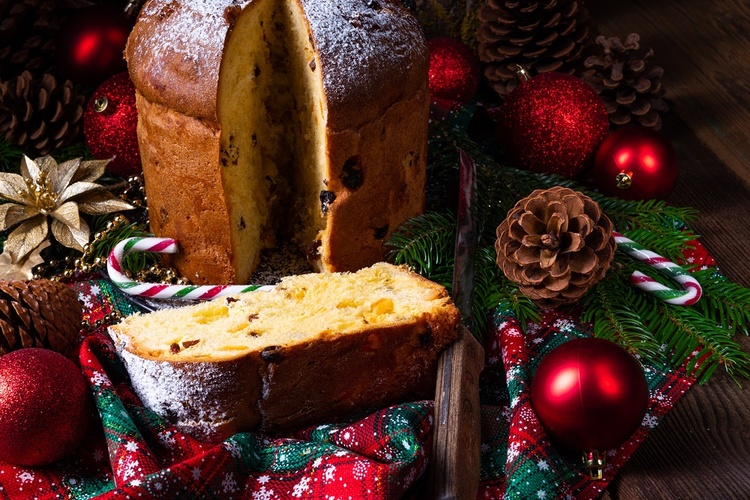
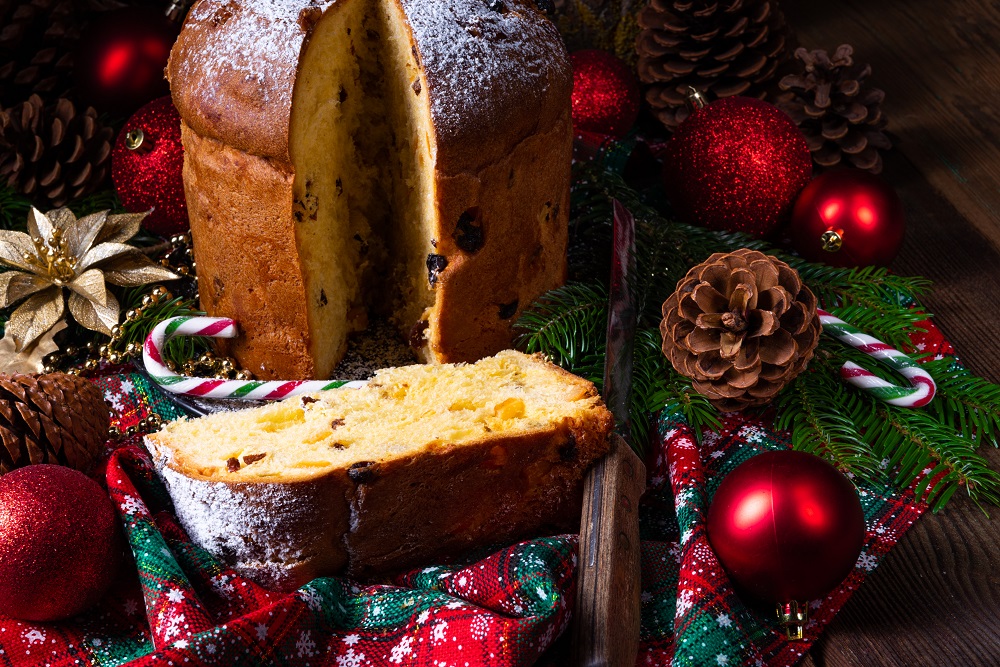
Panettone and pandoro, both examples of sweet bread, are popular across the country and embody the flavours of the festive season.
Traditionally, Italians give the festively wrapped cakes as gifts, as they symbolise luck and prosperity through the New Year.
Literally meaning “big bread,” panettone is a sweet, eggy cake that is traditionally dotted with candied and dried fruit (though we love the festive varieties, such as hazelnut or chocolate), then rises into a domed shape as it bakes.
With origins in Milan, this specialty is made with a whole lot of love and effort; the dough alone takes 30 hours to rise!
Meanwhile, pandoro is made from a rich, eggy dough, not unlike a French brioche, explaining its name of “golden bread”.
The sweet is baked in an eight-pointed star-shaped pan that gives it its signature form.
It is modelled after the mountains near Verona, where it was first made.
In fact, the earliest versions of pandoro were made during the era of the Venetian Republic, when trade had made the region extremely wealthy; some are said to have been served covered in gold leaf!
These days, we tend to dust pandoro with a small amount of vanilla-flavoured icing sugar instead – the “snow” on the top of the mountains!

Panettone and pandoro. (Photo: iStock)
Bagpipes in piazzas
No Italian Christmas would be complete without the sound of bagpipes.
Everywhere from the piazzas of Rome to remote hillside villages, the Zampognari (pipers) continue the tradition of festive bagpipe playing that dates back to ancient Roman times.
Traditionally, the pipers were shepherds who, in a bid to make some extra money, would travel down from their mountain homes at Christmas time to perform for the townsfolk in their markets squares.
This tradition is particularly popular in the central and southern regions of Abruzzo, Basilicata, Campania, Calabria, Molise, Puglia and Lazio.
The traditional dress of the piper is made of short breeches with criss-crossed leather leggings, sheepskin vests with a woollen cloak and peaked cap; there are regional variations such as velvet jackets or neckerchiefs, but the look of the piper remains mostly the same it has for centuries.
Historically, the piper is accompanied by a shawm, a medieval woodwind instrument; however, today’s pipers are usually accompanied by an oboe player.
They play traditional music, with a popular song being the Christmas hymn, Tu scendi dalle stelle (You come down from the stars).