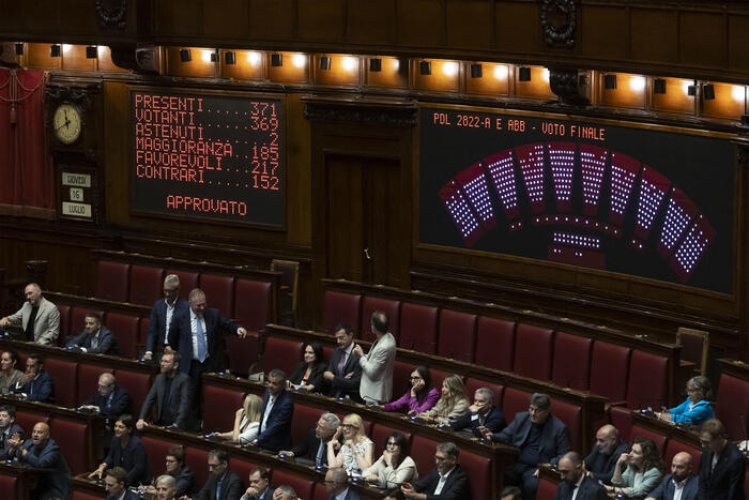
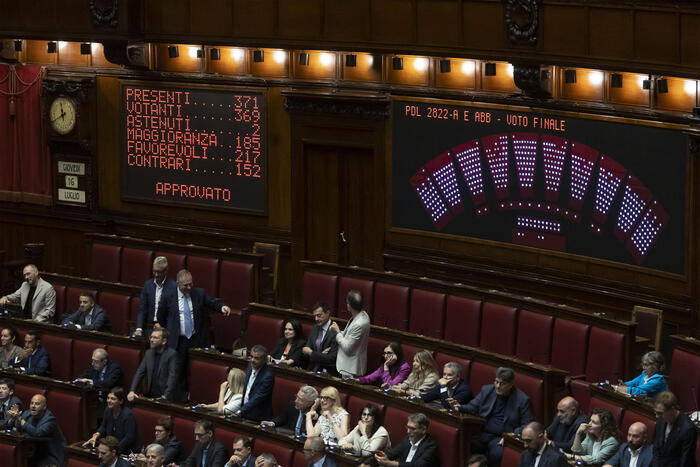
ROME – Italy’s Chamber of Deputies has approved the government’s new electoral reform at its first reading, sending the bill to the Senate for further debate.
Dubbed the “Stabilicum” by the governing coalition and the “Melonellum” by the opposition, the legislation passed with 217 votes in favour, 152 against and two abstentions.
The reform introduces a proportional representation system with a majority bonus for any coalition securing at least 42 per cent of the national vote. Under the proposal, the winning coalition would receive an additional 70 seats in the Chamber of Deputies and 35 in the Senate, up to a maximum of 220 lower house seats and 113 Senate seats, excluding representatives elected overseas.
If no coalition reaches the 42 per cent threshold in either chamber, seats would instead be allocated under a fully proportional system.
The legislation retains closed party lists in multi-member constituencies. An amendment that would have reintroduced preferential voting, while keeping party leaders at the top of each list, was defeated by just one vote earlier in the week, receiving 187 votes in favour and 188 against.
The narrow defeat fuelled speculation of government backbenchers voting against their own coalition and intensified political tensions ahead of the final vote.
Before the bill was approved, opposition MPs displayed placards in the chamber reading “Meloni has failed,” “Electoral law = fraudulent law,” and “The majority no longer exists: go home.”
Democratic Party leader Elly Schlein accused Prime Minister Giorgia Meloni and her allies of hypocrisy.
“How much hypocrisy there is in this chamber from those who have betrayed Meloni,” Schlein said. “Who is it that has betrayed whom? This has become Meloni’s only obsession.”
Five Star Movement leader Giuseppe Conte criticised the government for prioritising electoral reform while, he argued, “wages are falling and fuel prices are soaring.” He accused the governing coalition of trying to “change the rules of the game” in order to move “from stability to permanence in power.”
Riccardo Magi, secretary of the liberal +Europa party, described the bill as “an electoral coup,” while Matteo Richetti, parliamentary leader of Azione, argued that the government was effectively introducing direct election of the prime minister without changing the Constitution.
Opposition also came from the political right. Edoardo Ziello, of Futuro Nazionale, criticised the decision to retain closed lists and claimed the reform amounted to “an attempt by the centre-right and centre-left to build a cordon sanitaire against General Roberto Vannacci.”
Government MPs defended the legislation as a means of ensuring greater political stability.
Alessandro Colucci, of Noi Moderati, argued that if the opposition truly believed it could win the next election, “it should consider this electoral law both fair and worthwhile.”
Forza Italia MP Nazario Pagano said the objective had been to “find a balanced solution that fully respects the rulings of the Constitutional Court.”
From Brothers of Italy, MP Giovanni Donzelli turned the defeat of the preferential voting amendment into an attack on the opposition.
“You scored a point and celebrated as though you had won the World Cup for preventing Italians from expressing their voting preferences,” he said.
The bill also requires parties to nominate their preferred candidate for prime minister in their electoral platform, while respecting the constitutional powers of the President of the Republic. Failure to indicate a candidate would render a party list inadmissible.
The reform also changes rules governing signature collection, exempting parties that had formed a parliamentary group in at least one chamber by 31 December 2025, and introduces permanent provisions allowing voters living away from their registered residence to cast their ballots more easily.
Among the most controversial provisions is a restructuring of the Overseas Constituency, approved through a centre-right amendment passed by secret ballot with 203 votes in favour and 133 against.
For elections to the Chamber of Deputies, the current four overseas geographical districts would be reduced to two: one covering Europe, and another combining the Americas, Africa, Asia, Oceania and Antarctica. For the Senate, the overseas constituency would become a single nationwide district.
The changes prompted an immediate backlash from Democratic Party MPs elected abroad.
Fabio Porta, who represents South America, described the amendment as “a travesty” and “a politically motivated manipulation of the electoral law, designed not to improve representation but to secure a few extra seats for those who have failed to win the support of Italian communities overseas.”
His colleague Toni Ricciardi, elected in the Europe constituency, called the reform “an extremely serious act” and “an unprecedented abuse of process,” arguing that “when they cannot win votes, they simply redraw constituencies and electoral boundaries to gain a political advantage.”
Christian Di Sanzo, elected in the North and Central America constituency, echoed those concerns, accusing the government of “erasing the representation of Italians abroad” and “destroying the relationship between elected representatives and voters that has been built over two decades of overseas voting.”