MELBOURNE – Creativity lies, at least in part, in the ability to notice the details that most people overlook. And sometimes it is those very details that stay with us, shaping the memories that define our lives.
For graphic designer and creative director Francesca Zucchi—”of projects, not of people,” as she is quick to point out—the detail that opened the door to an entirely new world was a graphic design studio in Udine that she happened to visit as a child with her aunt.
“It struck me as such a strange and fascinating place,” she recalls, describing a studio filled with sketches, halftone screens, light tables and precision knives. It was there that she first realised she wanted “to work with images and words”—an ambition that never left her and eventually led her to enrol at the Giovanni Sello Art Institute in her hometown.
After high school and a brief period studying at DAMS (Disciplines of Arts, Music and Performing Arts) at the University of Bologna, Zucchi felt increasingly drawn to design. She enrolled in a European Union-funded course that not only gave her the opportunity to learn from some of Italy's emerging graphic design talents—including Francesco Messina, Ferruccio Montanari, Giorgio Camuffo, Artemio Croatto, Laura Morandini and Roberto Duse—but also took her to London, where she visited a number of leading international design studios.
“At the end of the course I went up to Francesco (Messina) and asked if I could become his apprentice,” she says with a smile. “He agreed, and that's how I started working with him.”
A few months later, another of the course mentors, Giorgio Camuffo, became Creative Director at Fabrica, the Benetton Group's communication research centre, co-founded by photographer Oliviero Toscani and Luciano Benetton.
That connection led Zucchi to collaborate on several communication projects for the Benetton Group while also introducing her to the young international creatives working at Fabrica. Once that experience came to an end, she returned to Udine and rejoined Messina's studio, where she would remain for the next eighteen years.
It was there that she truly developed as a designer, finally bringing together the two passions that had inspired her since childhood: words and images. Alongside publishing, she also worked on music projects, exhibition and museum design, and corporate communication.
“It was an extraordinary training ground, and I came out of it a different person,” she says.
When that chapter closed, a new one began, both personally and professionally. She moved to Venice, where her partner lived, and launched her freelance career, collaborating with some of Italy's leading publishing houses. Her work has included book covers and editorial design for publishers such as Bompiani, Laterza, Rizzoli, Skira and Il Saggiatore.
In 2022, while attending the launch of a children's poetry book by Ilaria Rigoli—illustrated by Ilaria Faccioli and designed by Zucchi herself—she met Grazia Gotti, one of the founders of the Junior Poetry Festival in Castel Maggiore, near Bologna.
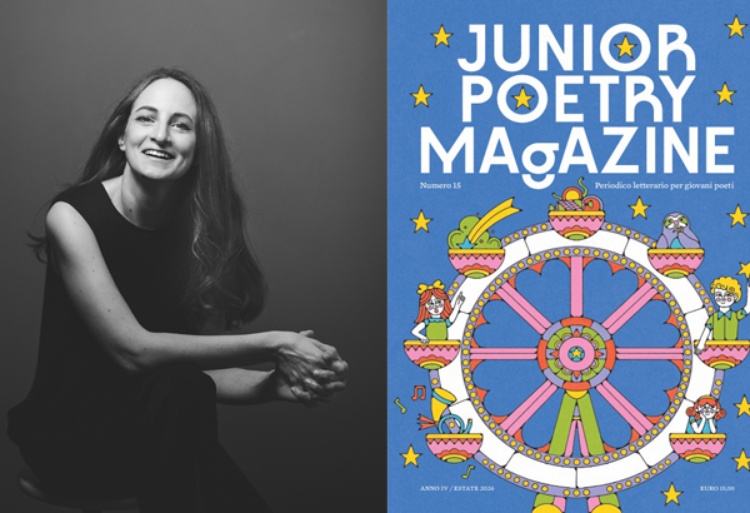
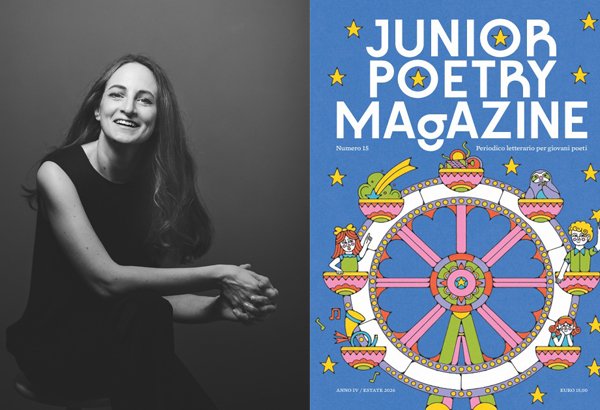
Since 2019, the festival has welcomed children and young people from across Italy to explore the language and imagination of poetry. Thanks to Zucchi and Rigoli, it has since grown into a beautifully crafted publication: the Junior Poetry Magazine.
Designed for readers aged eight to fourteen, the magazine is a carefully curated editorial project that combines poetry, wordplay and creative activities to encourage children to explore language in all its forms. Through thoughtful graphic design, colour and interactive content, each issue becomes a small work of art centred on a different theme. Every edition features a new group of poets and illustrators, offering fresh perspectives and new ways of seeing the world.
Zucchi affectionately describes it as “my playground.”
Through sophisticated editorial design, she creates multiple layers of reading, making the magazine accessible and engaging for such a wide age range.
Although the publication is aimed at young readers, it does not feature poems written by children. Instead, its purpose is to introduce them to accomplished poets and show them what poetry can be, inspiring them to discover their own voice.
“Every issue includes paper inserts and postcards that encourage children to write their own poems and send them to us,” Zucchi explains. She envisioned “a serial anthology, printed on the same lightweight paper traditionally used for anthologies, released in instalments with every issue, in sixteenth-sheet sections, complete with instructions on how to bind it into a book.”
Curiosity and a commitment to constant exploration seem to define Zucchi's work. She approaches every project with remarkable care, whether designing books that have brought her into contact with figures such as Umberto Eco and Nobel Prize winner Olga Tokarczuk, or creating a magazine for children, whom she believes deserve the same respect and attention as any adult audience.
Through posters, activities, illustrations and poetry, the Junior Poetry Magazine becomes a small laboratory of discovery—a place where young readers can encounter the beauty of language, find inspiration and develop a lifelong relationship with poetry.
Its originality has already earned it a place in more than one hundred bookshops. The magazine is distributed throughout Italy and internationally, reaching cities including New York, Barcelona, Brussels and Athens. An English-language edition is also due to be released soon.
And at a time when reasons for optimism can sometimes seem hard to find, perhaps poetry—and young people—still have the power to light the way.