For decades, the second and third generations of Italian-Australian families have gone looking for the same thing: a birth certificate from a small town in Calabria or the Veneto, and with it an Italian passport. Google Trends data shows that search has never been busier in Australia than it is now, at the very moment Rome has made it far harder to succeed.
A decade of growing interest
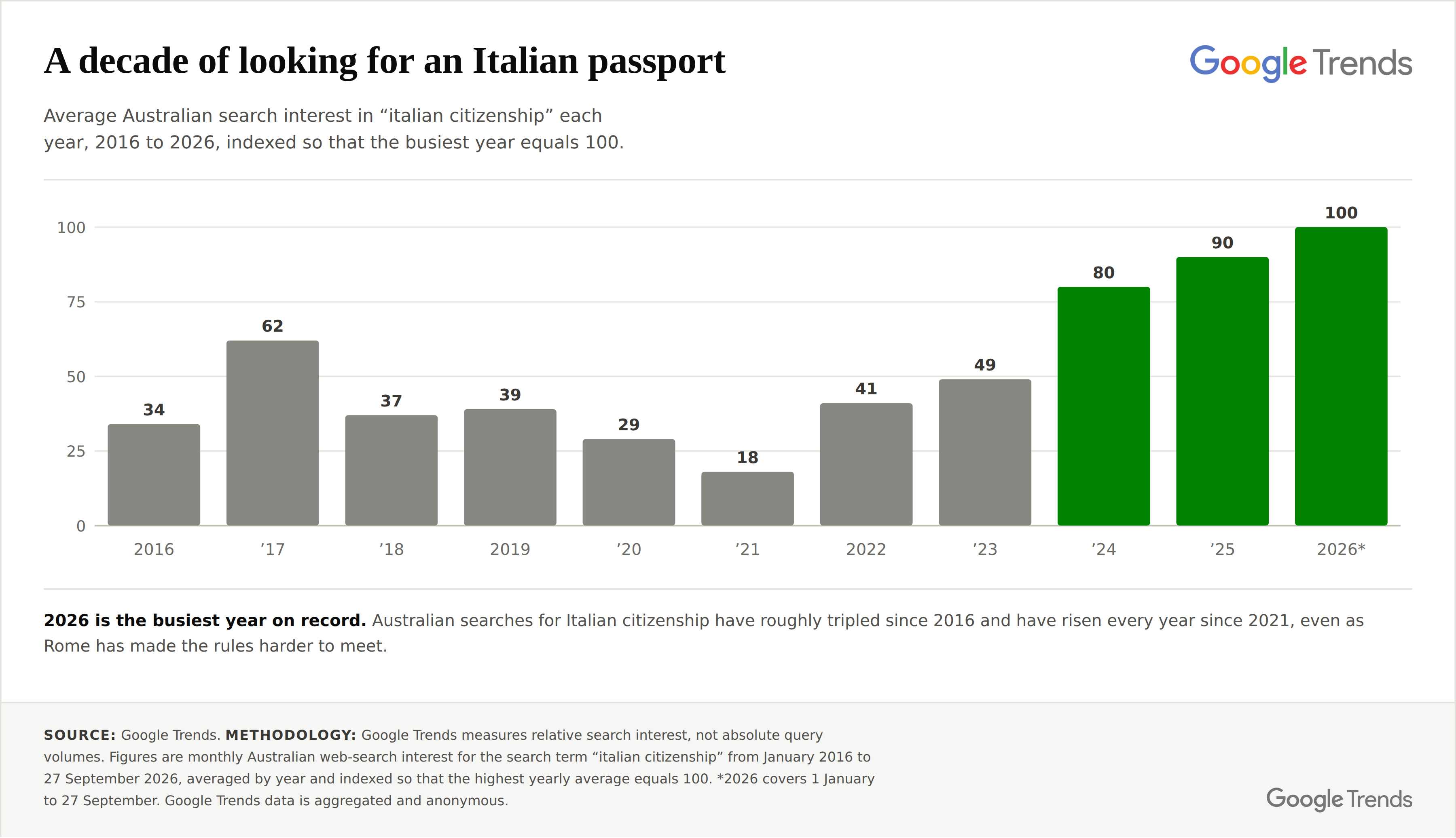
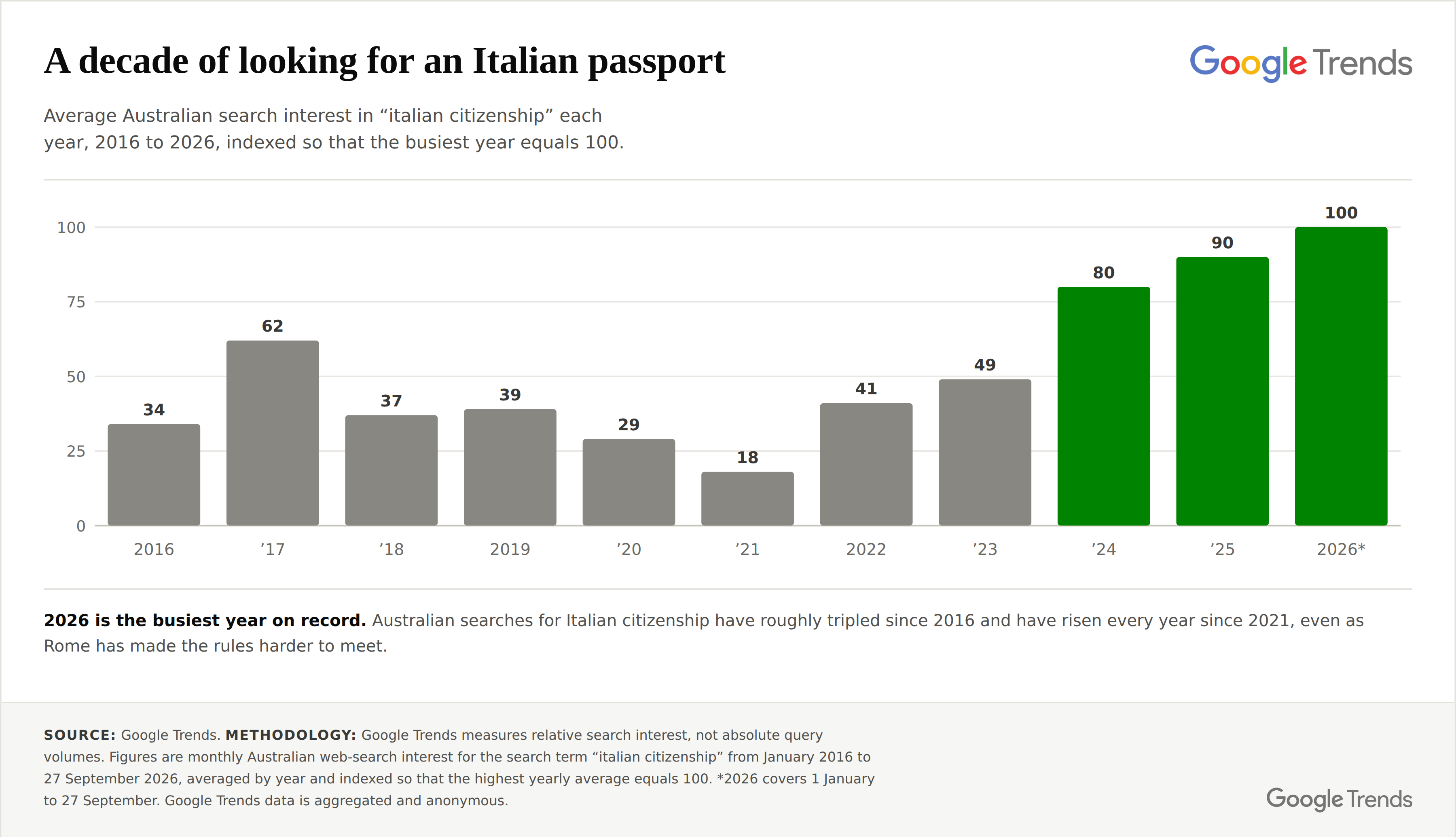
Australian searches for “italian citizenship” have roughly tripled since 2016, and 2026 is the busiest year on record. Interest dipped during the pandemic, when consulates closed and travel stopped, then climbed every year from 2021. The last three years are the three highest in the series.
Behind that curve is a large population. More than a million Australians claim Italian ancestry, and about 160,000 were born in Italy.
Every twist in the law brings a spike
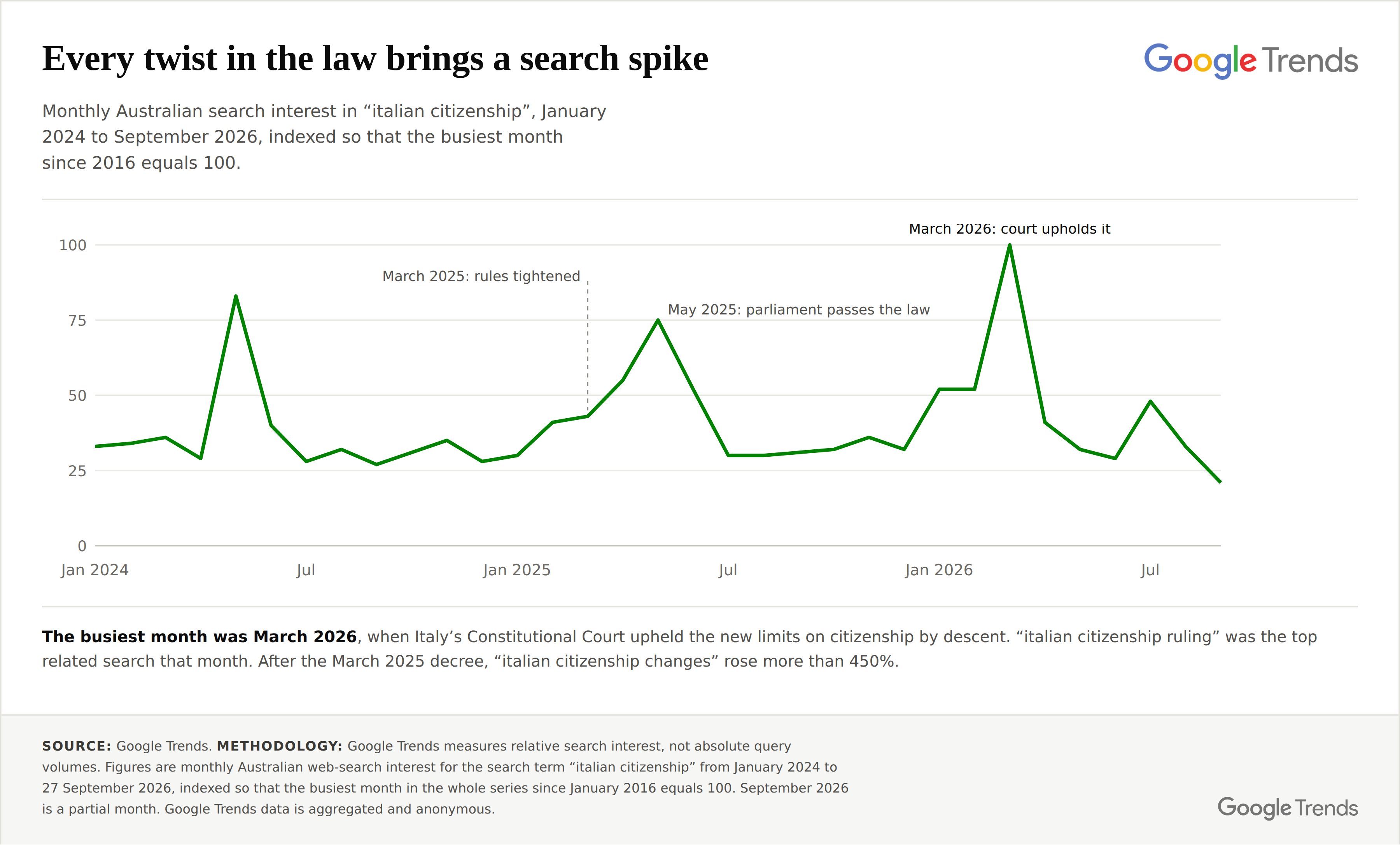
On 27 March 2025 the Italian government issued a decree that ended citizenship by descent beyond two generations. In broad terms, an applicant now needs an Italian-born parent or grandparent, and there are further conditions for those born abroad. Applications already lodged, or with an appointment confirmed before that date, are assessed under the old rules. Parliament converted the decree into law in May 2025.
Australian searches tracked each step. They rose through April 2025 and peaked in May, when the law passed. In the months after the decree, “italian citizenship changes” rose more than 450 per cent as a related search.
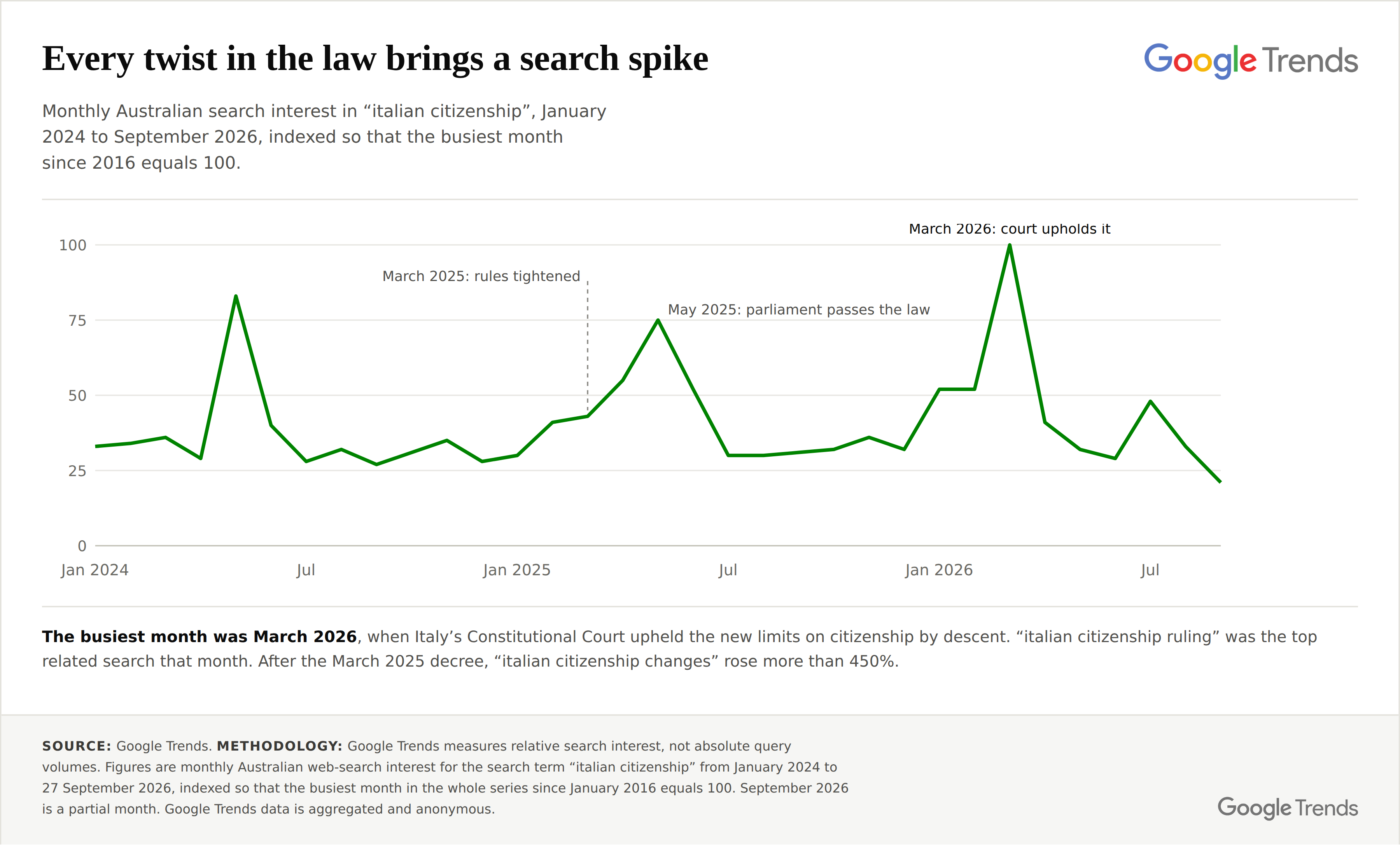
The busiest month in the entire series came in March 2026, when Italy’s Constitutional Court heard the challenge to the new law and upheld it. “italian citizenship ruling” was the top related search that month. The court confirmed that people who applied before 27 March 2025 keep their place under the old rules.
The matter is not finished. In July 2026 the court referred questions about the law to the European Court of Justice, which leaves the position of descendants unsettled for some time yet.
Where in Australia people are looking
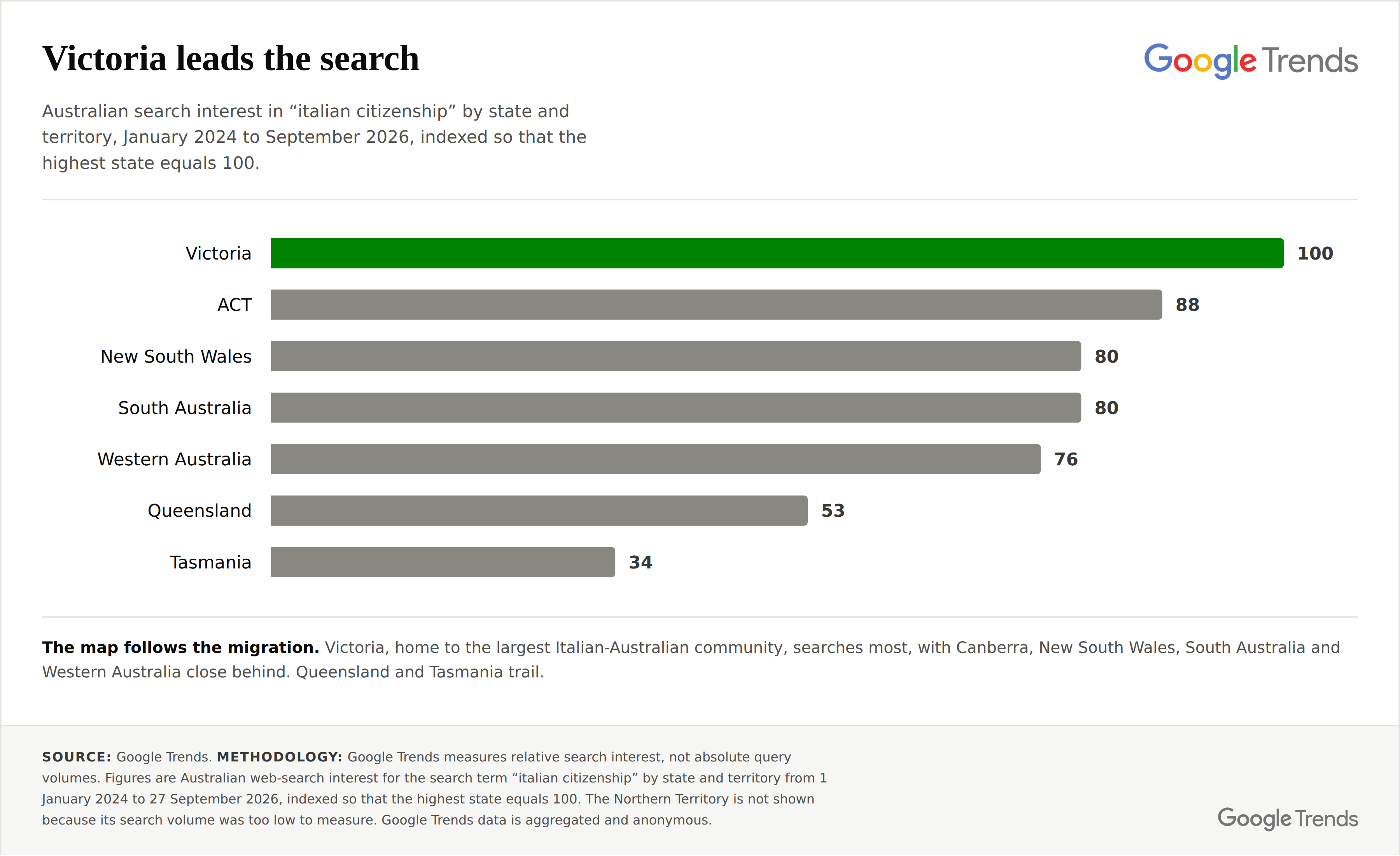
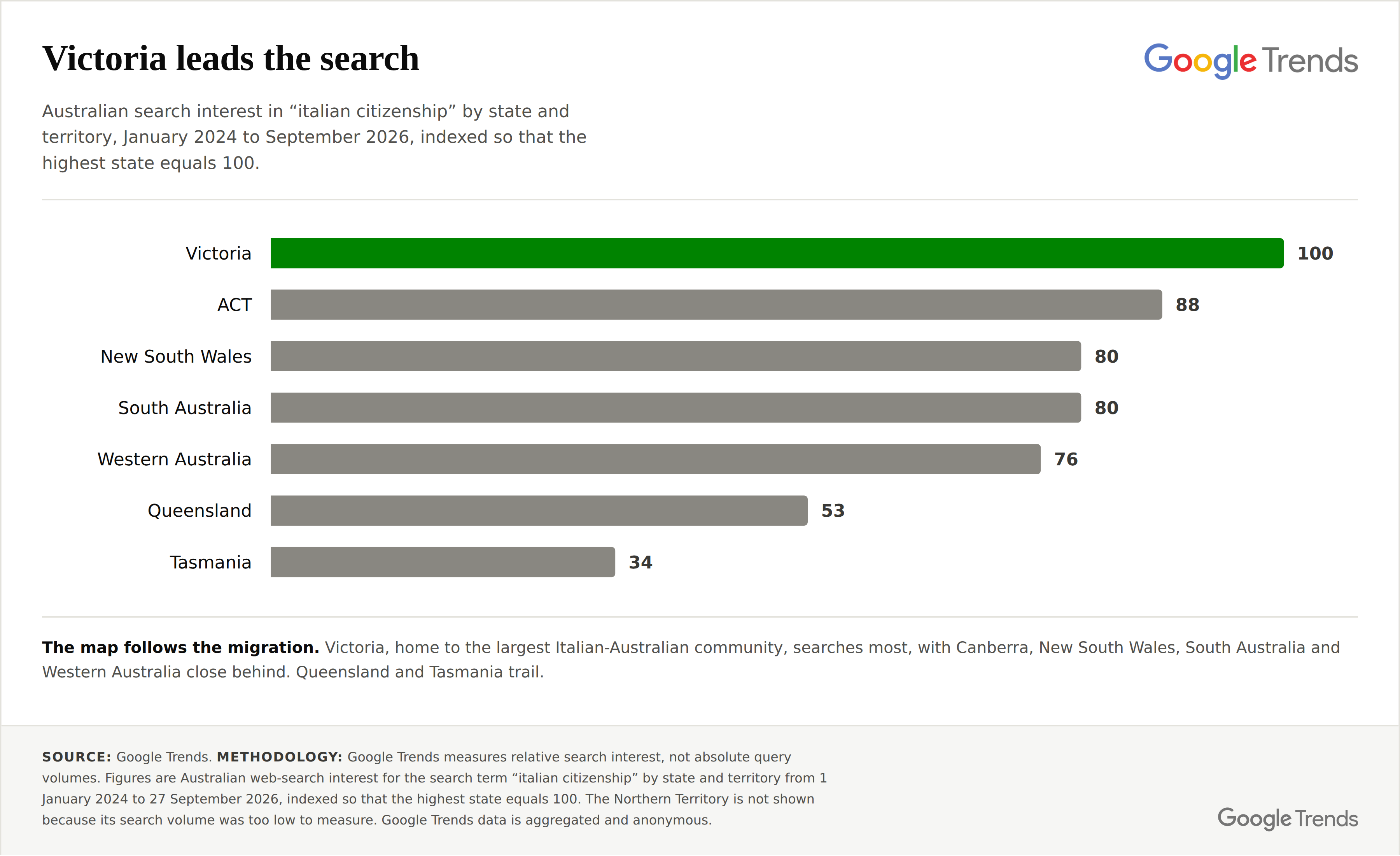
Victoria, home to the largest Italian-Australian community, searches most. Canberra, New South Wales, South Australia and Western Australia are close behind, while Queensland and Tasmania trail.
Australia is not the centre of this story
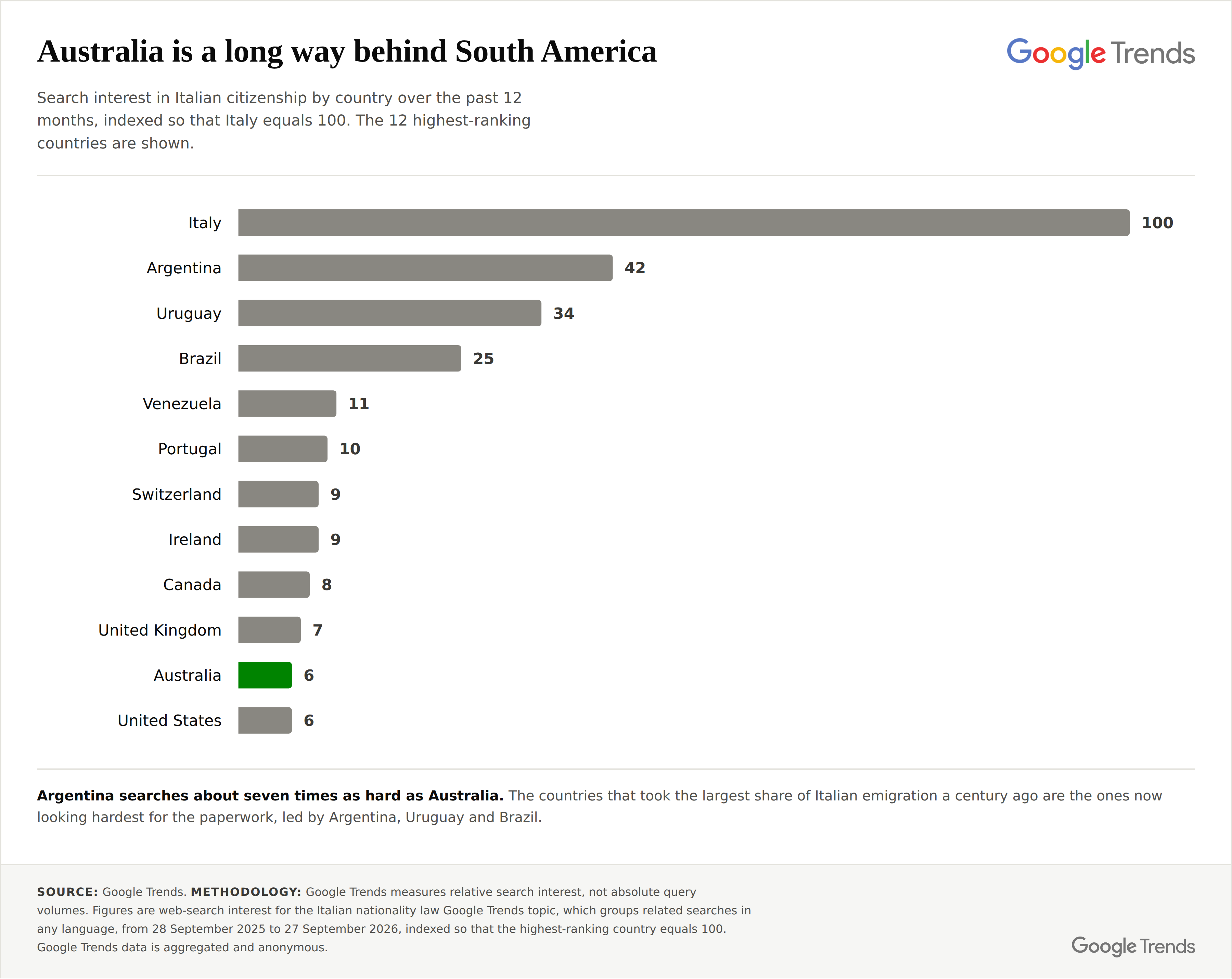
Seen from Rome, Australia is a minor part of the queue. Measured against the rest of the world over the past year, Argentina searches for Italian citizenship about seven times as hard as Australia, and Uruguay and Brazil are also far ahead. Those are the countries that received the largest share of Italian emigration, and their descendants are the ones the new law affects most.
What people actually type
The most common related search in Australia, by a distance, is “italian citizenship by descent”. Behind it come practical queries: how to get it, how to apply, citizenship by marriage, and the requirements. The fastest-rising searches of the past two years all point the same way: “italian citizenship changes”, “new italian citizenship laws” and “italian citizenship ruling”.
Put together, the picture is of a community that has kept looking even as the door has narrowed. The searches did not fall away when the rules changed. They went up.
About the data
Figures are from Google Trends for Australia and were collected on 28 September 2026. Google Trends measures relative search interest on a 0–100 scale rather than absolute search volumes, so numbers can only be compared within the same chart. Yearly, monthly and state figures use the search term “italian citizenship”, indexed within each chart. The comparison between countries uses the Italian nationality law Google Trends topic, which groups related searches in any language, over the 12 months to 27 September 2026. Weekly figures for this subject are small and volatile, so monthly averages are used. Ancestry figures are from the 2021 census as reported by SBS. Details of the law are from Law 74/2025 and the Constitutional Court’s 2026 ruling. This article is general information, not legal advice. Google Trends data is aggregated and anonymous.