Under the free trade agreement reached with the European Union in March, Australia will remain the only country outside Italy allowed to keep calling its sparkling wine prosecco at home. Exports will have to find another name over the next decade. Google Trends data shows what is at stake in the domestic market: no other Italian drink comes close.
In a league of its own
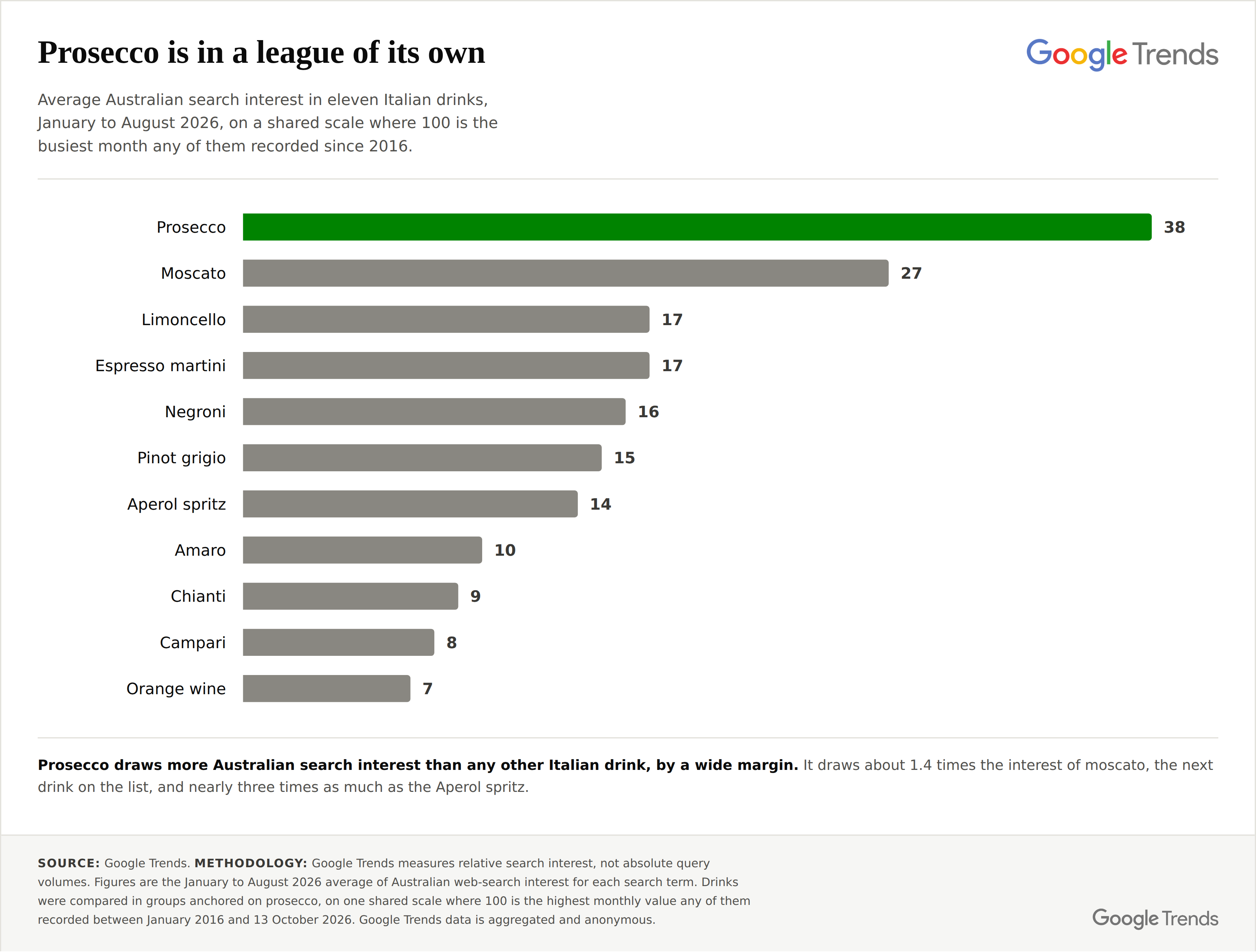
Over the first eight months of 2026, prosecco drew about 1.4 times the Australian search interest of moscato, the next drink on the list, and nearly three times as much as the Aperol spritz.
The order is itself a small surprise. Moscato, the sweet wine that rarely features in fashionable drinks writing, outranks the negroni, the espresso martini and the Aperol spritz. Chianti, once the shorthand for Italian wine in Australia, now sits near the bottom of the list.
A decade of prosecco
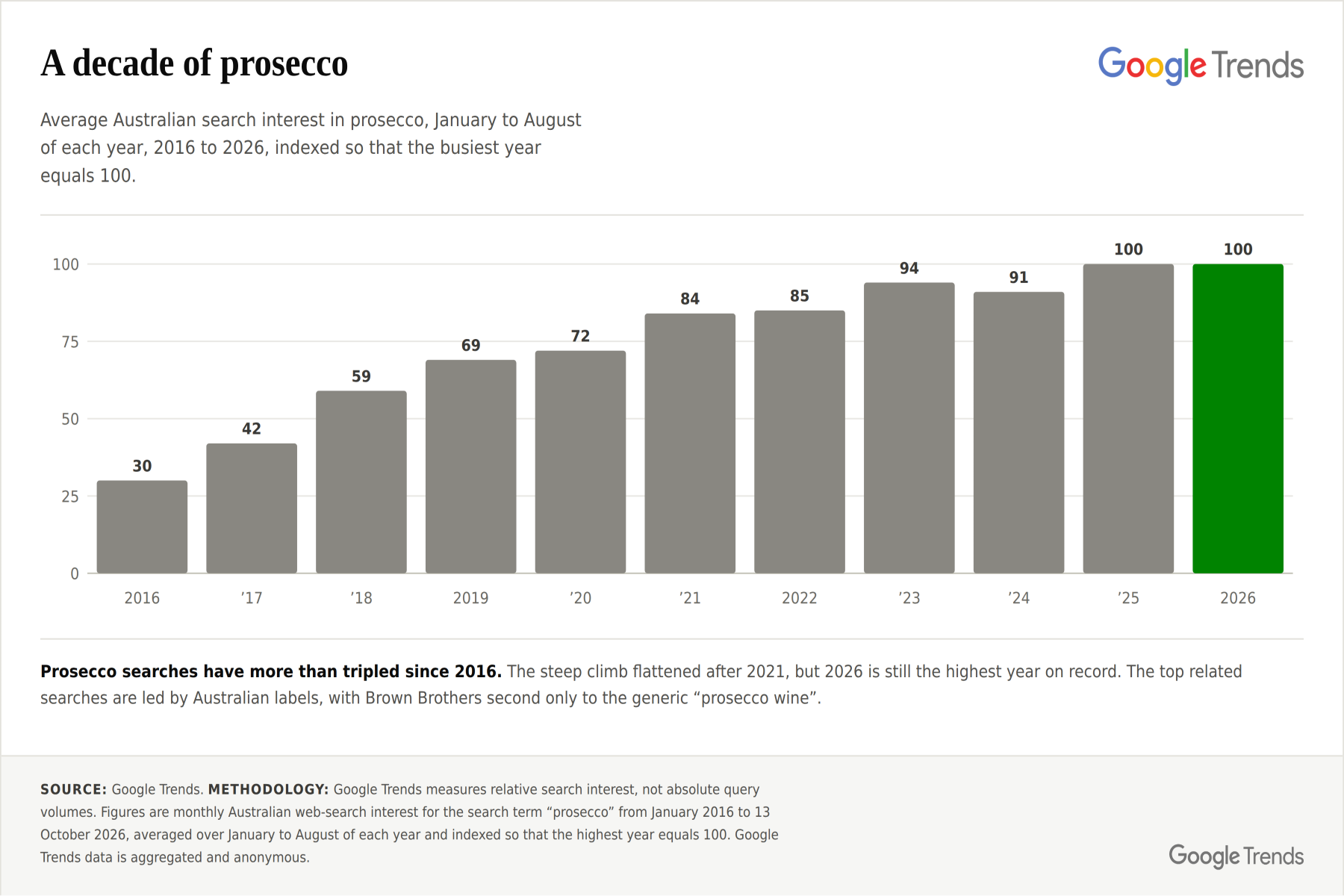
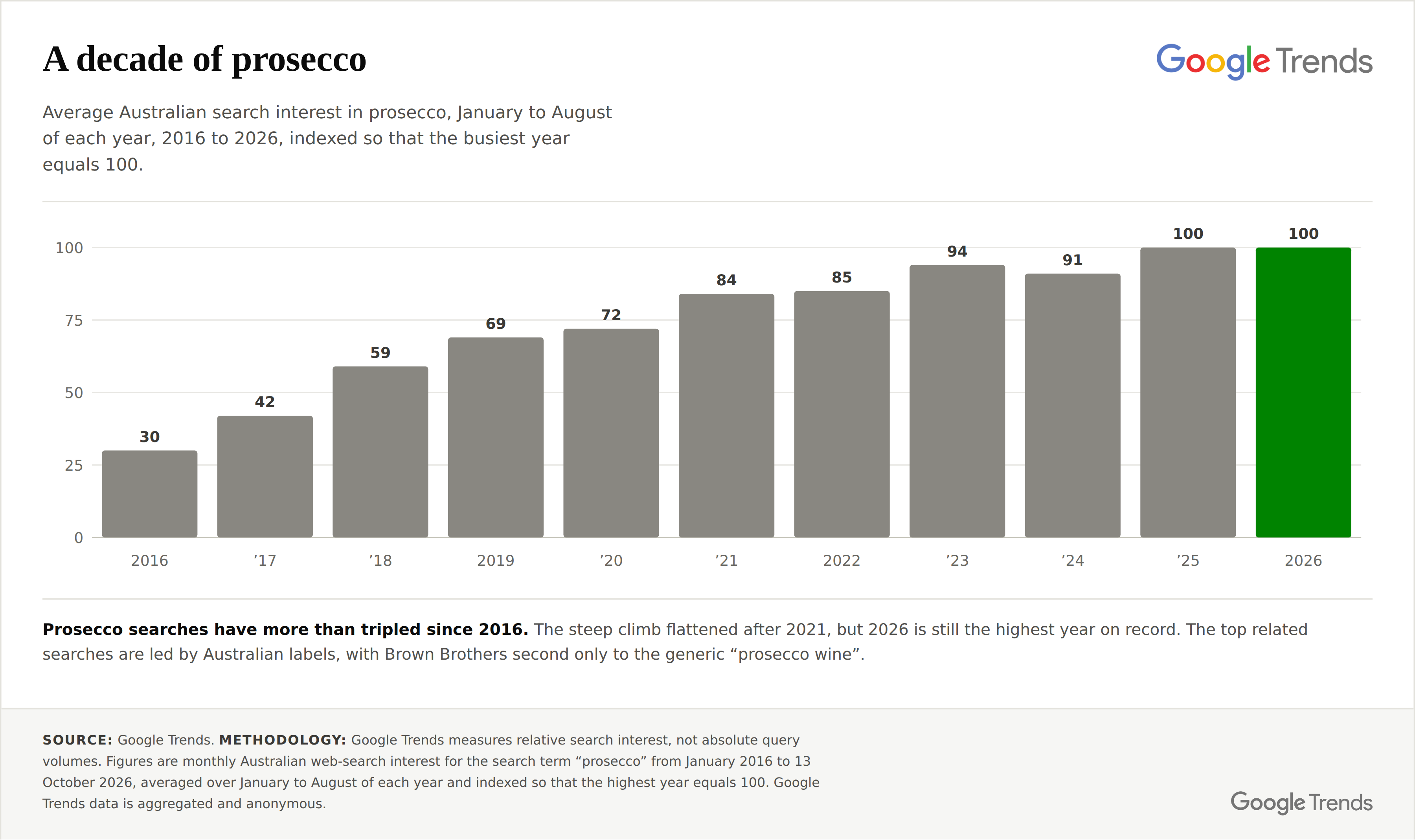
Prosecco searches have more than tripled since 2016. The steepest climb came before 2021 and the line has flattened since, but 2026 is still the highest year on record.
What Australians search alongside it is the local part of the story. After the generic “prosecco wine”, the most common related search in the past year is “prosecco Brown Brothers”, the King Valley producer, ahead of “rose prosecco” and “best prosecco”. Other Australian labels appear among the fastest-rising searches, as does a non-alcoholic one, Heaps Normal, which was the single fastest riser of the year.
December does the heavy lifting
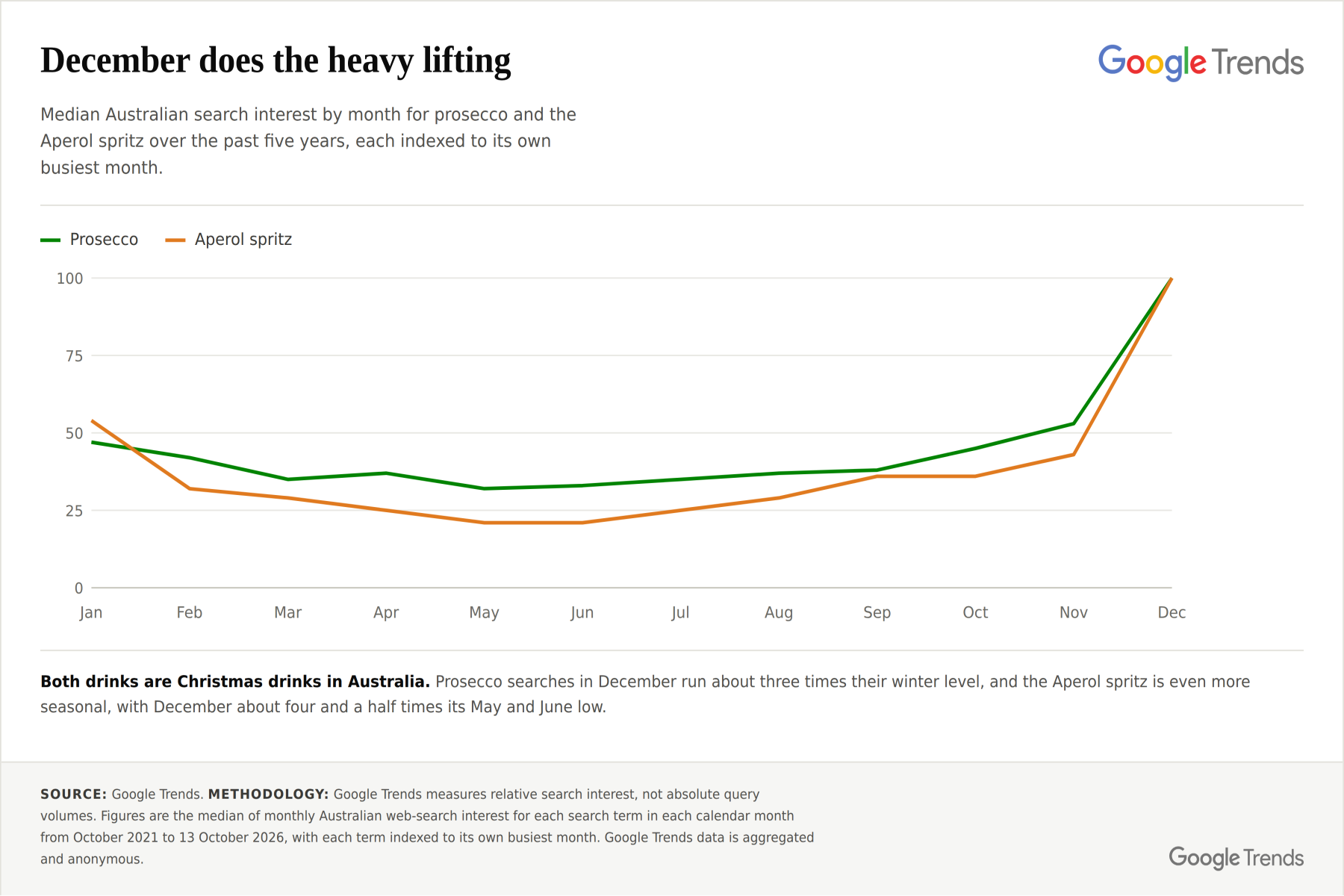
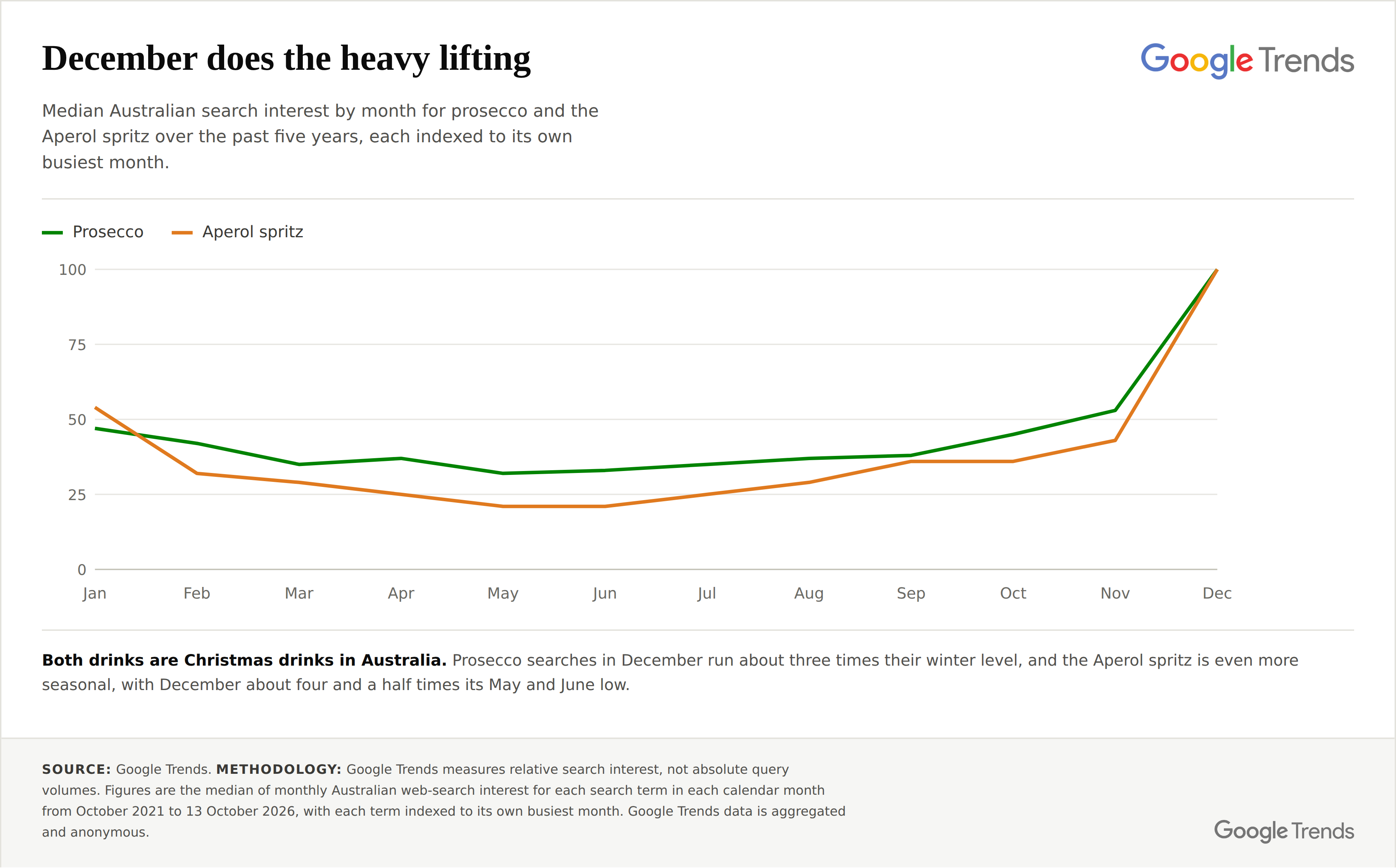
Both of Italy’s best-known aperitivo drinks are, in Australia, Christmas drinks. Prosecco searches in December run about three times their winter level. The Aperol spritz is even more seasonal, with December about four and a half times its May and June low.
The risers and the fallers
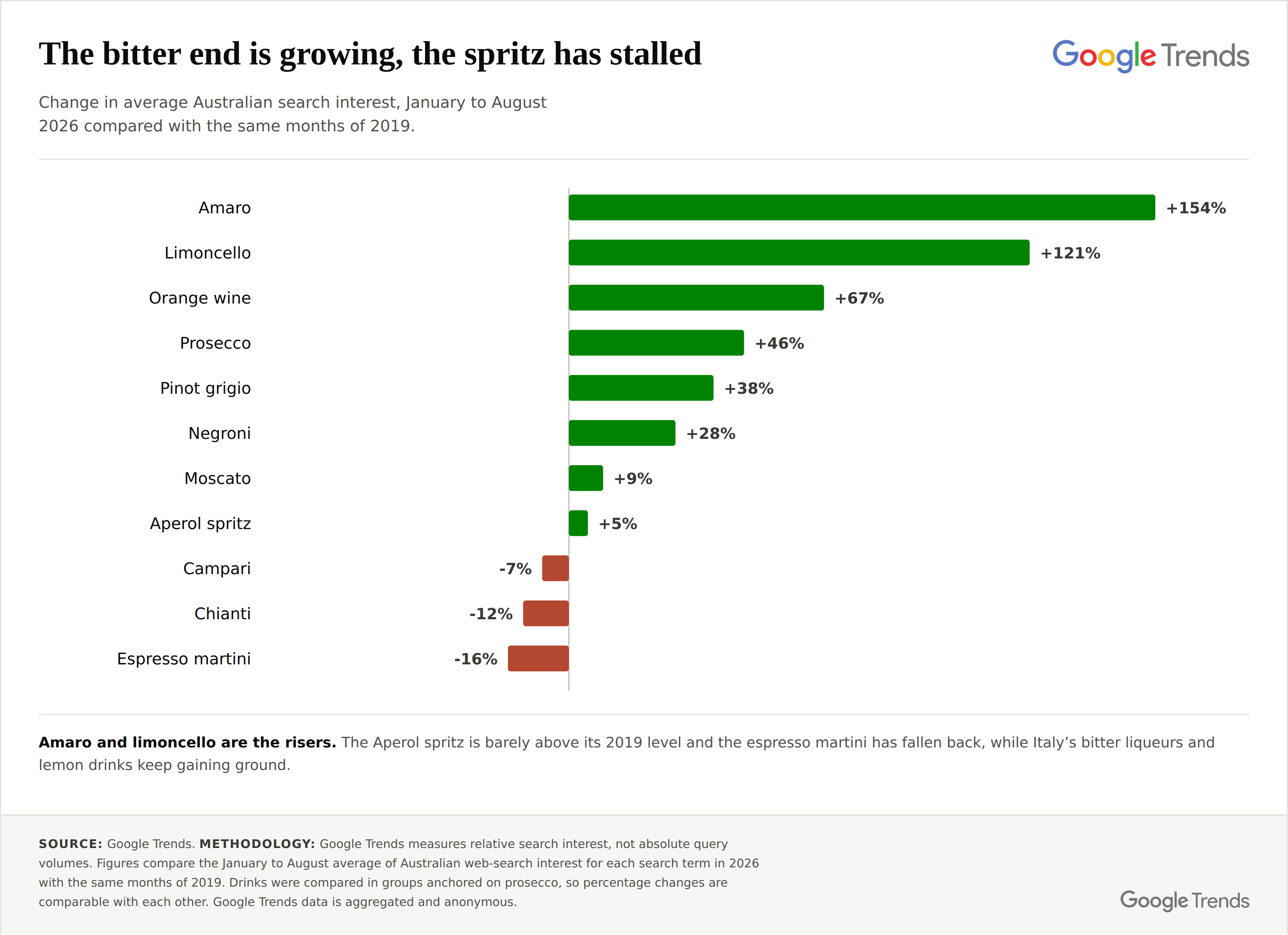
The spritz boom, though, has run its course. Aperol spritz searches in 2026 are only about 5 per cent above their 2019 level and below where they were last year. The espresso martini has fallen further, down about 16 per cent on 2019 and more than 40 per cent from its 2021 peak.
Growth has moved to the bitter and the sweet. Amaro, the family of Italian bitter liqueurs, has risen about 150 per cent since 2019. Limoncello is up about 120 per cent, and its most common related search is not the liqueur itself but the limoncello spritz. Among the fastest-rising limoncello searches are those for Zonzo Estate in the Yarra Valley, which makes its own.
Among wines, orange wine is at a record level and pinot grigio continues to grow, while chianti has drifted lower. Negroni searches remain well above 2019 but have eased from their 2023 peak.
What the trade deal means for the name
Australia’s prosecco industry began in 1999, when Otto and Elena Dal Zotto planted the first vines at Whitfield in the King Valley. Wine Australia figures show prosecco entering the country’s top ten white varieties in 2019, with 9,936 tonnes crushed, up from 2,189 tonnes in 2015.
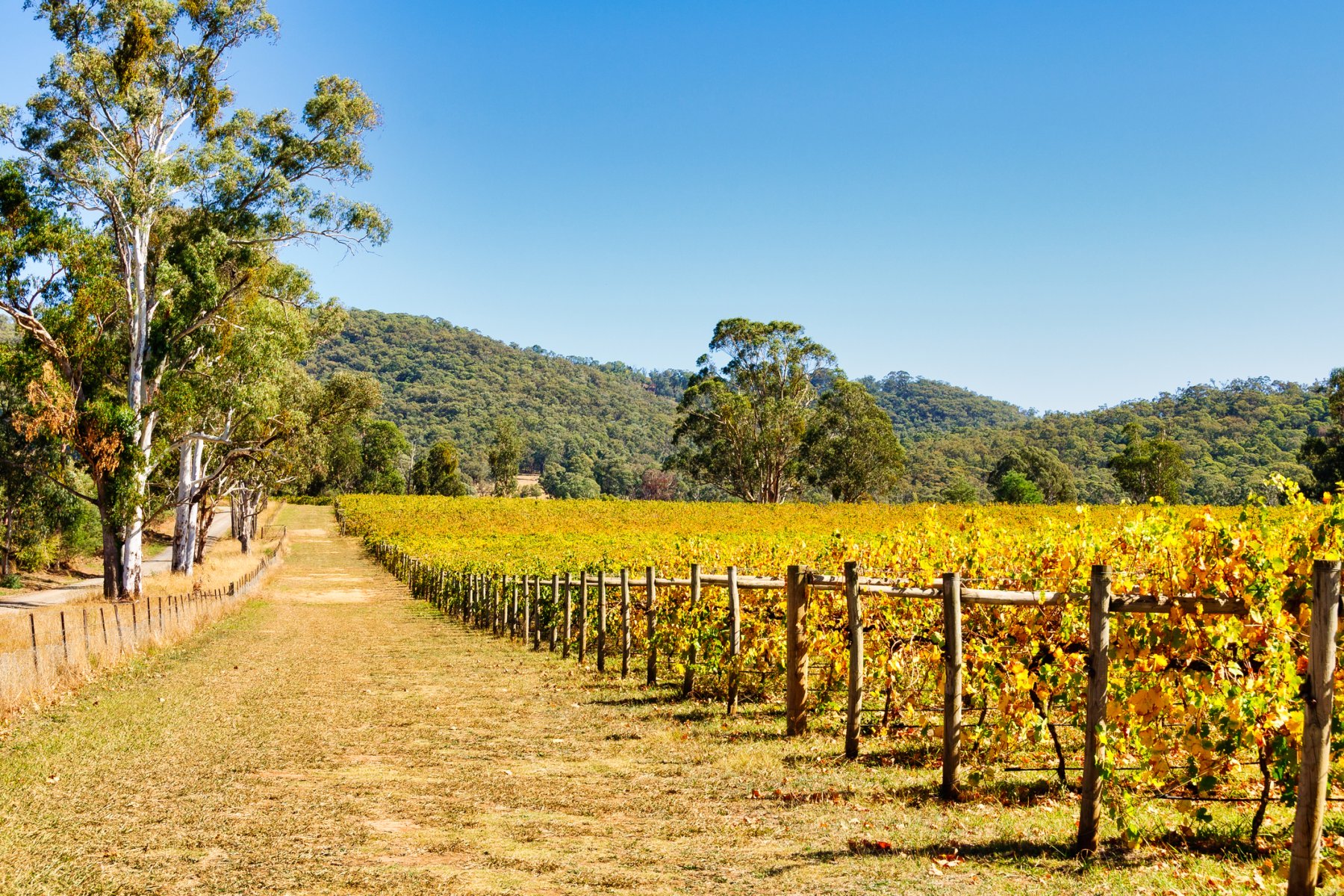
More than 45 per cent of Australian prosecco now comes from the King Valley, and about 95 per cent of it is drunk in Australia. That last figure is why the March agreement matters: the name stays where almost all the wine is sold, and only the small export trade, mostly to New Zealand, will need a new one within ten years.
Brown Brothers winemaker Katherine Brown told the ABC the industry would make the best of it: “It’s just prosecco by another name — let’s see how creative we can get.”
About the data
Figures are from Google Trends for Australia and were collected on 13 October 2026. Google Trends measures relative search interest on a 0–100 scale rather than absolute search volumes, so numbers can only be compared within the same chart. Comparisons between years use the January to August average of each year. Drinks were compared in groups anchored on prosecco so that they could be ranked on one scale. All items are measured as search terms. Seasonal patterns use the median of each calendar month over the past five years. Trade agreement details and industry figures are from ABC News and Wine Australia. Google Trends data is aggregated and anonymous.