VENICE - The 2026 Venice Biennale — already being dubbed the “Biennale of Discord” — pulses with contradiction and surprise. The controversy surrounding the readmission of Russian artists has ignited fierce international debate, but beyond the political storm, the media firestorm and the protests that erupted at the opening, the exhibition itself proves remarkably rich in unexpected directions. Across the pavilions of the Giardini and the Arsenale, visions emerge that challenge the very language and preoccupations of contemporary art.
The Russian pavilion at the Giardini ranks among the most contested of this edition. Following the initial uproar, it remains open only during press and industry preview days, closing its doors to the general public until November 22.
The installation The Tree is Rooted in the Sky unfolds through recorded performances projected onto giant screens, meditating on the relationship between humanity and nature — and on the global flower trade, whose long supply chains and industrial processes quietly alter the very life of the blooms they handle.
Belgium delivers one of the most immersive experiences in the entire Biennale. A living, sonic sculpture built from drums, tribal rhythms, chants and the rotating performances of dancers fills a space punctuated by fragile yet evocative terracotta signs bearing phrases such as “if will you.” The work reflects on the fragility of everyday life and its ever-accelerating pace, transforming the pavilion into a shared, collective happening.
The Italian Pavilion at the Arsenale presents Con te con tutto (With You, With Everything) by Chiara Camoni, curated by Cecilia Canziani. It offers a choral, participatory vision that invites visitors to rethink their relationship with the world through the exchange between material and immaterial forms of life.
New and existing works are combined according to a logic of reuse and transformation: recycled plastic, industrial offcuts and found objects become poetic elements capable of narrating the contemporary landscape and its ceaseless metamorphosis.
Japan’s pavilion, conceived by Ei Arakawa-Nash together with Lisa Horikawa and Mizuki Takahashi, turns the space into a playful and disorienting environment populated by objects associated with childhood — nappies, prams, dolls, toys. Visitors are drawn directly into everyday acts such as nappy-changing, which are elevated into ritual gestures.
Each participant receives a digitally generated poem weaving together imaginary biographies and historical references.
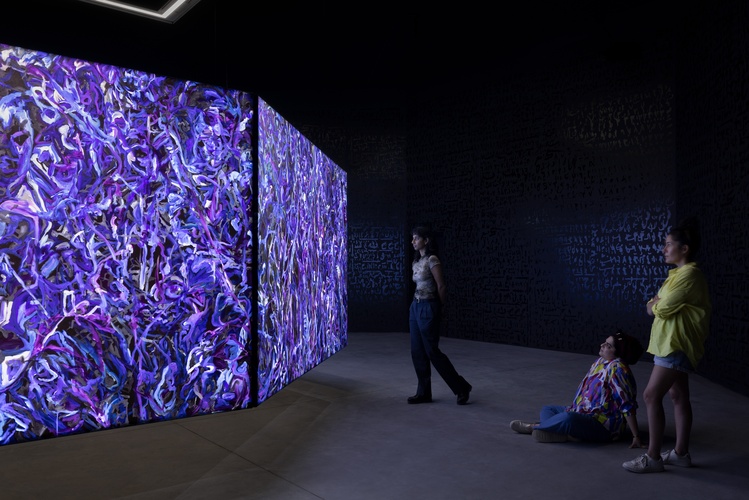
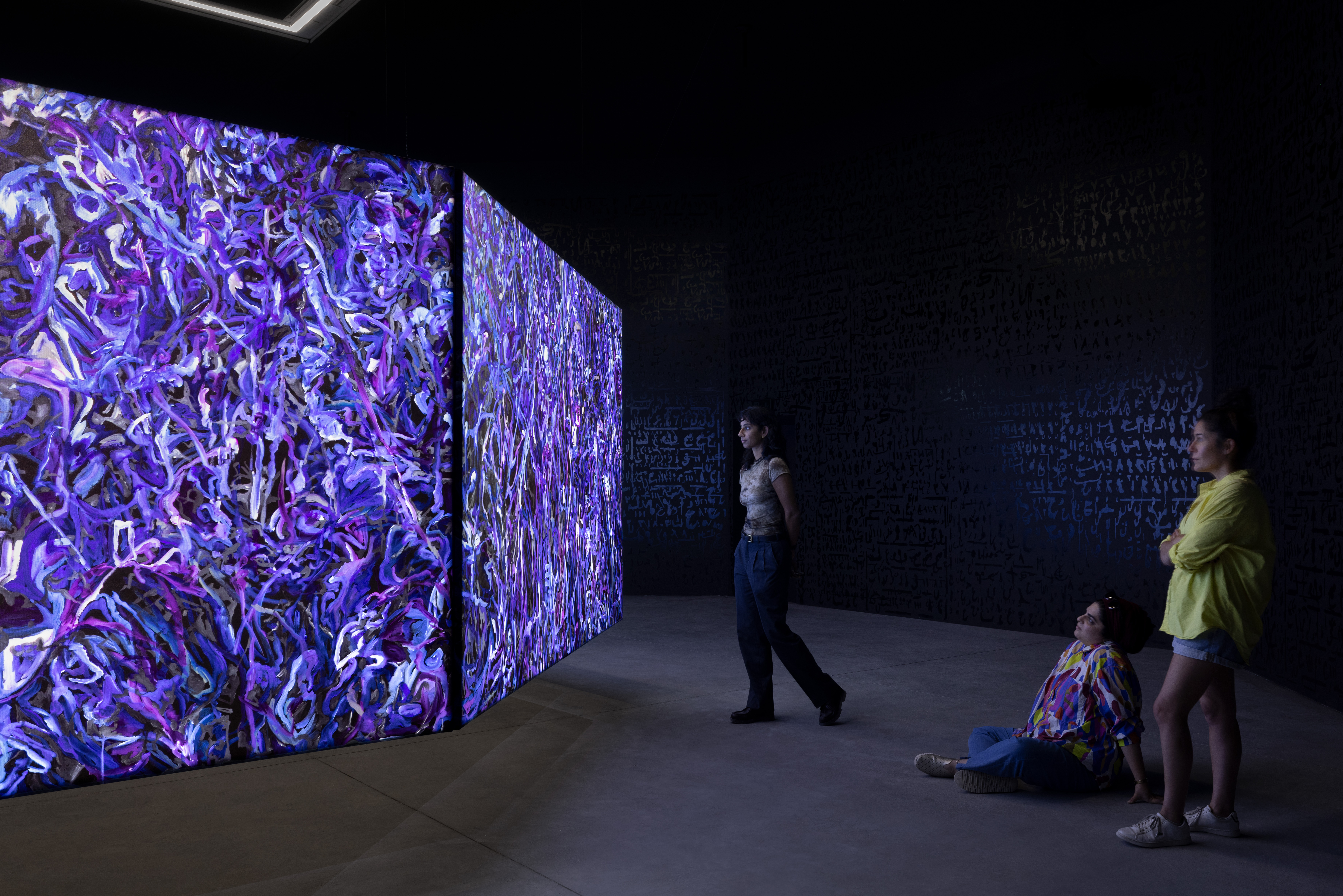
Lebanon, represented by Nabil Nahas, presents Don’t Get Me Wrong — a monumental painterly installation comprising a sequence of panels stretching a total of 45 metres. Palm trees and starfish are transfigured into fractal motifs that merge personal memory, Islamic geometry and American abstract expressionism. The result is an enveloping visual environment that draws the viewer into its interior.
The Holy See Pavilion, spread across the Mystical Garden of the Discalced Carmelites and the Santa Maria Ausiliatrice complex, stands apart for its contemplative depth.
Here, contemporary artists, musicians and poets enter into dialogue with visionary texts and listening practices. Works by Brian Eno, Patti Smith, Meredith Monk and Caterina Barbieri trace a slow, immersive journey rooted in silence, sound and meditation — in close harmony with the Biennale’s overarching theme, In Minor Keys.
Finally, Australia is represented by artist Khaled Sabsabi with the project Conference of One’s Self, curated by Michael Dagostino. Combining video, sound and immersive installations, the show reflects on identity, spirituality, migration and multicultural coexistence in contemporary Australian society.
Taken as a whole, this edition navigates between political tension and poetic openness, alternating spectacle with introspection — a Biennale very much of its fractured, searching moment.