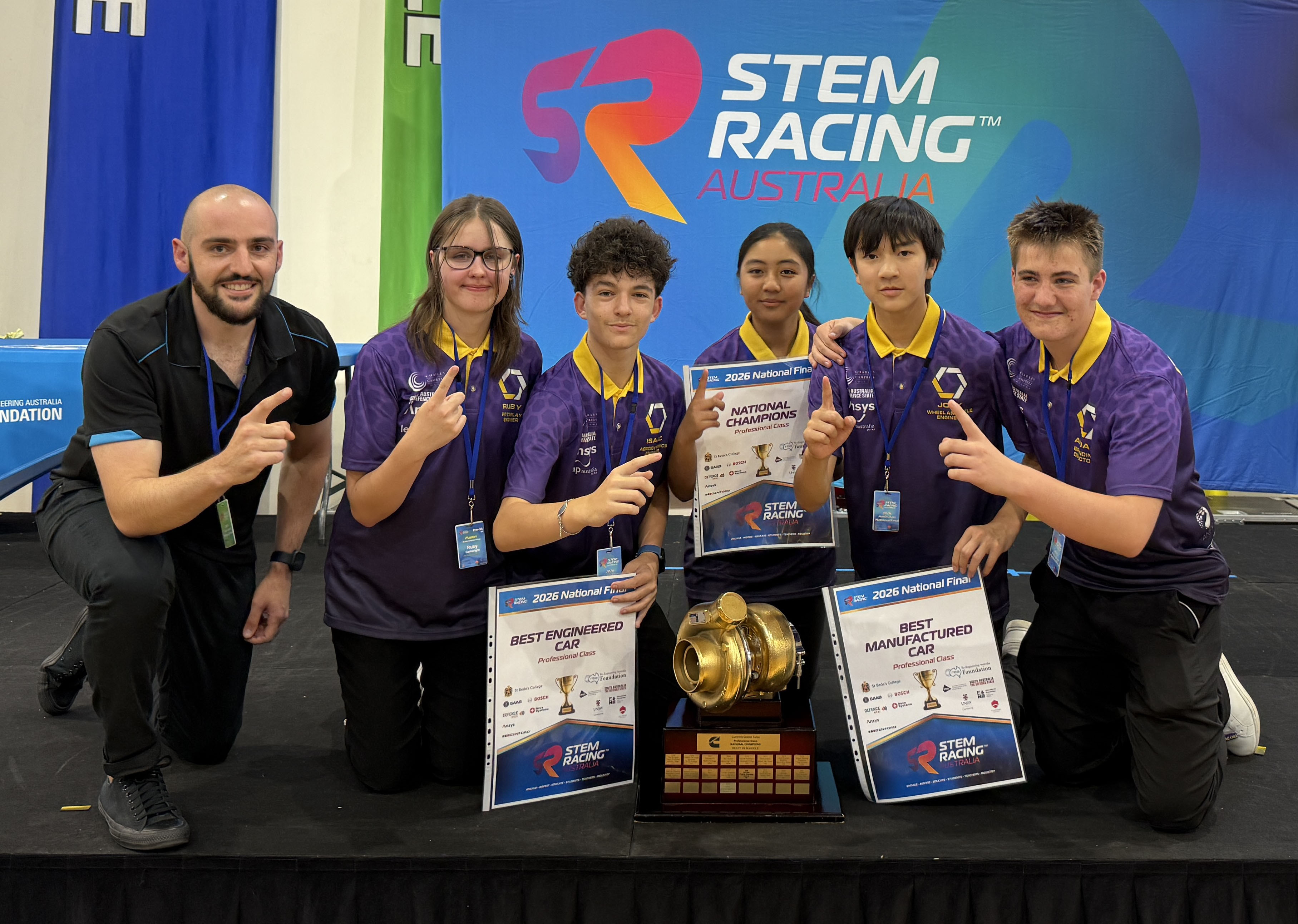
ADELAIDE – At Charles Campbell College in South Australia, a group of fifteen-year-olds has been spending hours after school and on weekends working toward one ambitious goal: a place on the world podium.
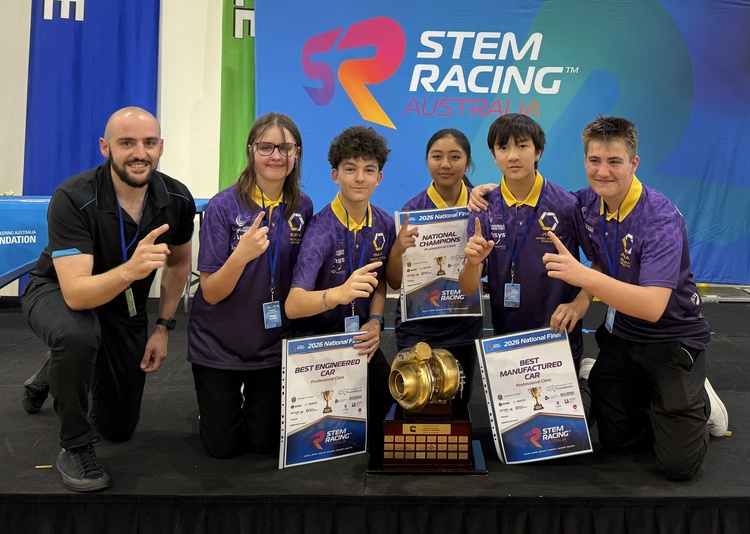
This is the story of Fusion — five students who reached the final of the 2026 STEM Racing National Championships, taking home the titles of Best Engineered Car and Best Manufactured Car, and earning a spot at the World Finals in Singapore.
STEM Racing is a global education programme backed by Formula 1, open to students aged 9 to 19, who are challenged to design, build and race their own miniature F1 cars powered by CO2 cartridges.
The programme has been running at Charles Campbell College for about seven years and has grown into one of its flagship initiatives, delivering remarkable results at state, national and international level. “It started as an extracurricular activity, but today it’s structured as a proper pathway, running from Year 7 through to Year 10,” explains Daniel Marotti, the school’s STEM and technology teacher who coordinates the project.
Fusion is no stranger to success. Last year the team won in the ‘development’ category, reserved for first-year participants; this year they claimed the top spot in the ‘professional’ category, the most competitive tier. At their first World Finals appearance in 2025, the students finished twelfth out of approximately 85 teams, while back in 2023 another group from the same school came second in the world.
“This is our third time at the World Finals and we’re hoping to get back on the podium — maybe even win,” Marotti adds. The finals will be held in Singapore between late September and early October, bringing together teams from around the world to present their high-performance mini racing cars under strict technical and marketing criteria, all assessed by the competition’s judging panel.
The secret behind Fusion’s competitiveness? Commitment and drive. “They work constantly — during lunch breaks, after school, on weekends,” says Marotti. “They’re genuinely motivated to be the best.” It’s a quality, he notes, “that can’t be taught, only encouraged.”
The students themselves agree. Aiden, Fusion’s spokesperson and Enterprise Director, puts it plainly: “There’s a huge amount of work involved, especially on the engineering side. We study advanced concepts in mathematics and aerodynamics that are normally covered in the final years of school or at university.”
The project goes well beyond building a car. It requires the kind of organisation you’d find in a professional racing team. Students take on clearly defined roles — engineers, marketing and communications leads, team manager, exhibition stand designer and Enterprise Director.
And, as in any F1 outfit, friction is part of the deal. “We spend a lot of time together, so sometimes we get on each other’s nerves,” Aiden admits with a laugh, “but working as a team has brought us really close.” Despite the pressures, no one has ever thought about quitting. “We just want to keep getting better,” he says.
Now all eyes are on Singapore. The team will need to build an entirely new car, adapting it to international regulations that are considerably more demanding than the national ones.
“It’s essentially a brand new project,” says Marotti — a challenge the group is approaching with a mixture of excitement and nerves.
Yet the value of STEM Racing extends well beyond the competition itself. Alongside the technical skills, the programme develops essential transferable abilities: teamwork, time management, meeting deadlines, problem-solving and communication. “It’s not just for students interested in engineering,” Marotti stresses.
“It opens up a lot of doors.” For some, the dream is to work in Formula 1 one day — and the World Finals offer a tangible pathway, including access to the Komatsu-Williams Engineering Academy, a three-year training programme with the renowned British team.
Behind the success, however, lies a financial challenge: to make it to Singapore, the school needs to raise around $50,000.
With approximately 1.8 million students taking part in the programme globally each year, reaching the World Finals is already a remarkable achievement. But Fusion isn't ready to stop there. “We want to do even better,” the students say.
And judging by their determination, that dream of a world podium may be closer than it seems.