VATICAN CITY - The bilateral relations between the Vatican and the United States need “a renewed commitment” and, if dialogue is to continue, both sides must “work tirelessly in favour of peace.”
That is the message coming from the Vatican following the meeting between the Pope and U.S. Secretary of State Marco Rubio.
The Holy See’s statement includes the customary formula of “cordial talks” — a phrase withheld only in the rarest of circumstances — yet the entire account is compressed into seven carefully weighed lines, where even the commas were deliberate.
Today’s meeting was therefore the first step toward mending the rift, following Donald Trump’s repeated attacks on Leo. Considerable caution on the part of the Holy See remains, however, and it is visible in the long hours that passed before any comment was released, while the American administration had already issued immediate reactions stressing “the strength of relations between the United States and the Holy See, as well as their shared commitment to peace and human dignity.”
On the eve of the meeting, the Vatican had not concealed a degree of anxiety: Cardinal Secretary of State Pietro Parolin had spoken openly of “strange attacks.”
Nobody today is calling the meeting a genuine turning point, but there is open talk of a tentative thaw. Leo is reopening to dialogue, though — as he has shown repeatedly in this first year of his pontificate — without giving any ground.
While the meeting had been requested by the American administration, it appears that it was Pope Leo himself who broke the ice, clearly restating all of the Holy See’s priorities.
The files on the table are numerous, and the time devoted to Rubio is not insignificant either, given Vatican audience standards and an especially packed day of engagements for the Pontiff.
In forty-five minutes, with no need for interpreters, the hottest topics emerge: the Middle East, with particular attention to Iran and Lebanon; conflicts scattered across the world, including forgotten ones in Africa; and the delicate question of Cuba, which calls for “attention to the suffering of that people,” Vatican sources are keen to stress.
Rubio then moves to the Secretariat of State to meet Parolin and the Vatican's “foreign minister,” Archbishop Paul Richard Gallagher.
There, the conversation turns again chiefly to Iran, focusing on the difficult negotiations currently underway, and once more to Cuba — for which Washington announced new sanctions precisely today, signalling its unwillingness to ease the pressure.
It is a file the Vatican holds particularly close, wary of a heavy-handed American intervention along the lines of what happened with Venezuela.
In the end, Rubio spent a total of more than two and a half hours inside the Apostolic Palace — no small thing, given that he is not a head of state. Trump's attacks feature in neither side's official statements.
There appears to have been only a brief mention by Rubio, reiterating that the tycoon had been misunderstood. In any case, that was not the meeting’s subject, as the Pontiff himself had already made clear on Tuesday evening while speaking to journalists as he left Castel Gandolfo.
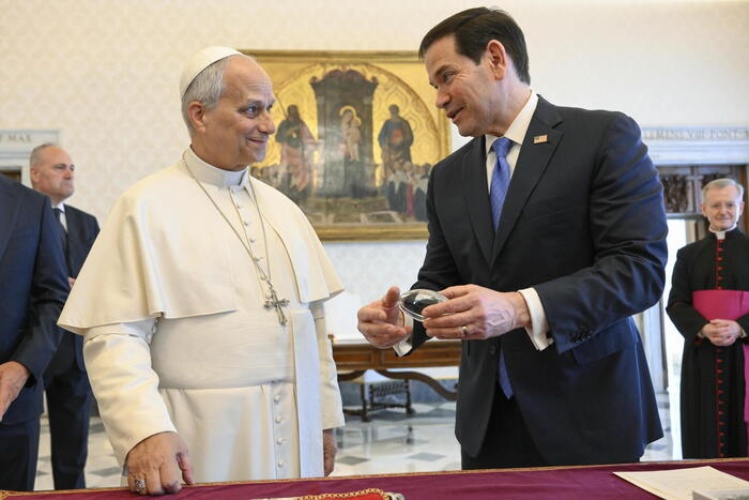
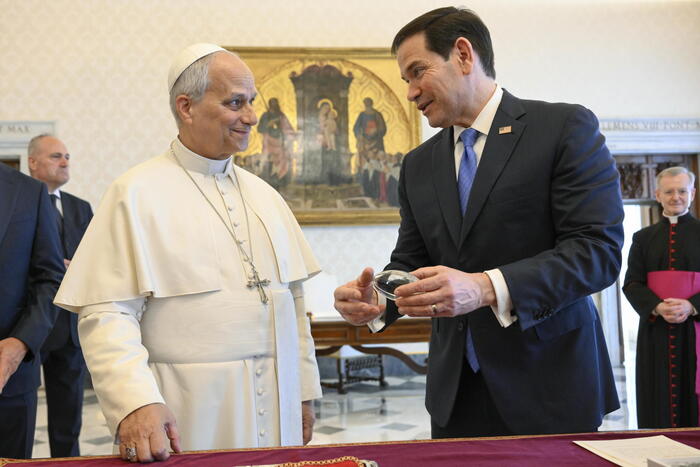
Photos and videos show faces that are broadly smiling — perhaps more so Prevost than Rubio, the latter known for a resolute manner that nonetheless remains open to dialogue.
The customary exchange of gifts rounds off the encounter. Rubio presents an olive-wood pen, while the Pope offers a baseball-shaped paperweight and feels compelled to explain: “What do you give someone who already has everything?” The Pope, in turn, presents an olive-wood pen and makes a point of noting that it comes from “the plant of peace.”
With the demanding Vatican appointment behind him, Rubio travels tomorrow to Palazzo Chigi for a meeting with Prime Minister Giorgia Meloni.