MELBOURNE – Around 90 Year 11 and 12 students from secondary schools across Victoria came together on 28 July for a day that gave them a first-hand insight into how the United Nations works.
Each year, around 4,500 students across the state take part in similar experiences through the global education program run by the Victorian division of the United Nations Association of Australia (UNAA).
Among its initiatives is a Model United Nations General Assembly, held not only in English but also in several other languages, including Italian, thanks to a partnership with the Victorian Association of Teachers of Italian (VATI).
The event gives students an opportunity to put their language skills to the test in a practical and challenging setting, while engaging with global issues and developing leadership, listening and negotiation skills.
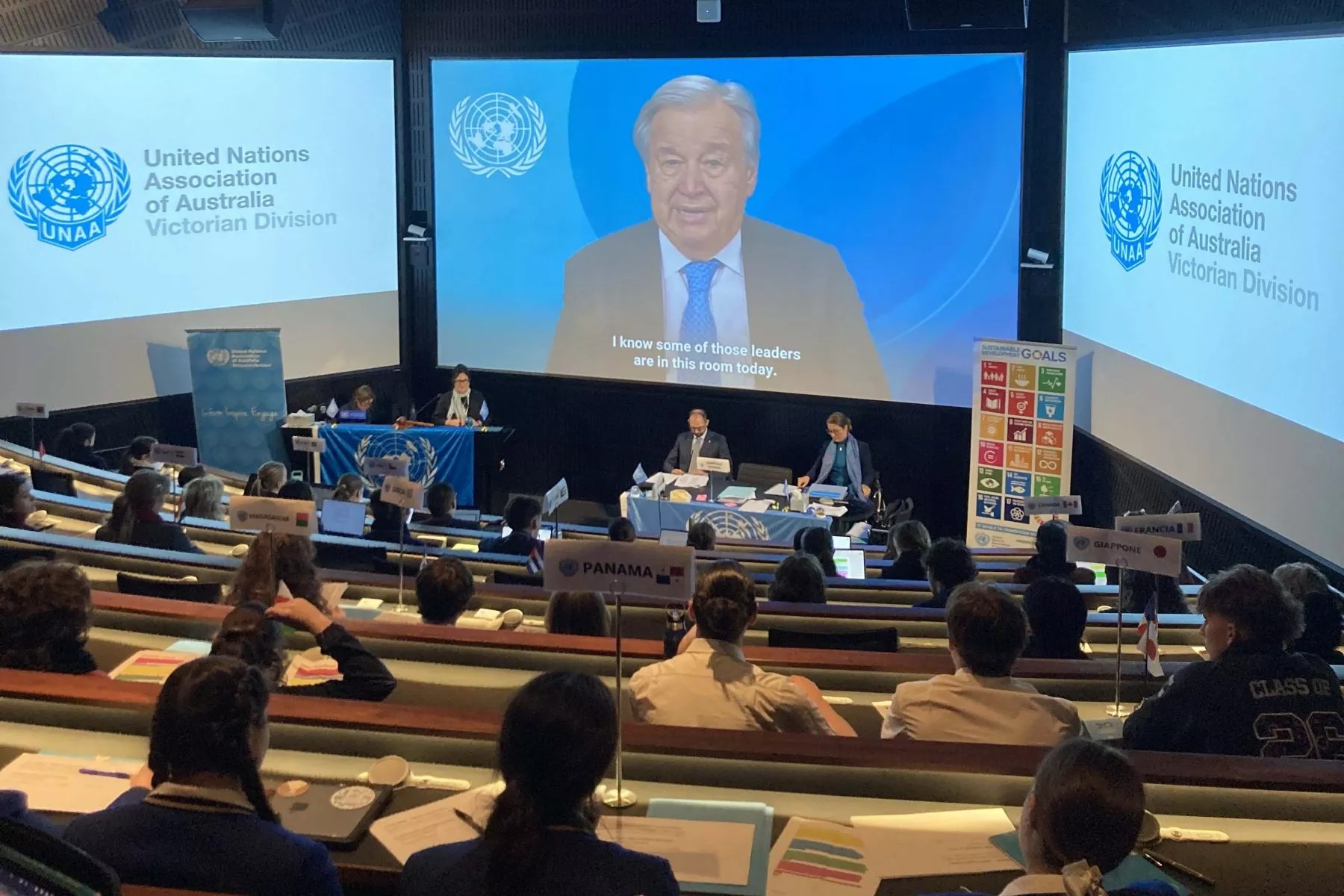
Inside one of the rooms at the Victorian Academy of Teaching and Leadership, the students became international delegates for a day. Divided into groups, they represented 25 countries and debated the topic Planet Ocean: Protecting the World’s Oceans, Seas and Marine Resources.
They were welcomed by UNAA Victoria Executive Manager Sally Northfield, who explained how the session would work before introducing a recorded message from United Nations Secretary-General António Guterres. He encouraged the students to see the simulation not simply as a classroom exercise, but as a way of understanding the complexity of international decision-making.
Taking part in a Model United Nations, Guterres stressed, means learning what it takes to help build “a better world”: preparation, a strong grasp of the facts and, above all, “the courage to see the perspectives of others”, while never losing sight of the needs of the most vulnerable.
Northfield echoed that message, reminding students that the major challenges facing the world today cannot be solved by individual countries acting alone.
“None of the global issues that countries around the world are facing today can be solved by one nation,” she said.
The only way forward, therefore, is through cooperation – precisely what students were being asked to experience through the simulation.
“It’s not a day of competition, but of collaboration, dialogue and negotiation.”
What made this particular event, organised in partnership with VATI, especially distinctive was that the entire session was conducted in Italian.
It offered students a very different way of using the language, far removed from traditional classroom exercises. Italian became a practical tool: they had to argue the position of the country they represented, put forward proposals, listen to other delegates and negotiate compromises in response to opposing views. Their teachers and a group of language assistants from Co.As.It. were on hand to support them throughout the day.
Italian Consul in Melbourne Chiara Mauri highlighted the value of bringing language learning and diplomacy together, describing the event as “much more than a diplomatic simulation”.
“It is an opportunity to learn how to engage with different ideas, to listen, to negotiate and to build shared solutions,” she said.
These skills, she added, are essential not only in international relations, but “for every citizen, and even more so for the global citizens you will be called upon to become”.
According to Mauri, the current international landscape makes exercises such as this even more meaningful. Conflicts, climate change, inequality, pandemics, food security and emerging technologies are all challenges that inevitably extend beyond national borders.
“No country, however powerful, can tackle the great challenges of our time alone,” the Consul said, highlighting the importance of multilateralism and the United Nations.
It is a system that, in her view, must continue to evolve. International organisations need to become more representative, efficient and capable of making timely decisions, but “renewing multilateralism does not mean calling it into question. On the contrary, it means making it stronger and better equipped to meet the needs of today’s world”.
The theme chosen for the simulation allowed students to apply those principles to a tangible global issue. Oceans cover more than 70 per cent of the Earth’s surface, regulate the climate and are home to extraordinary biodiversity, while also representing a vital economic resource.
For that reason too, “no country can act alone”: protecting the oceans requires shared responsibility and international cooperation.
The Consul concluded by expressing the hope that the hours spent in the room would not only help students improve their Italian, but also strengthen their “critical thinking and awareness of global challenges”, as well as their belief that dialogue and cooperation remain the most effective tools for building a better future.
Every student took an active role in the simulation, taking turns to deliver their position statement before the Assembly and outlining their assigned country’s stance on the issue under debate.
Once the opening statements had been delivered, the caucus began. The first stage was moderated by the Assembly’s Secretary-General, VATI consultant Alexander Parise, before moving into an unmoderated session in which students negotiated directly with one another in an effort to find common ground with other countries.
Following the consultations, delegates presented a series of amendments to the General Assembly, which were debated and put to a vote. In the final stage, the students reached a resolution agreed upon by all member states. The satisfaction on their faces was clear after an intense day that had tested both their language and diplomatic skills.
Parise, now in his second year as Secretary-General of the Italian-language simulation, has been involved with the project for many years, contributing both to the organisation of the event and to translating materials from English into Italian.
“That’s where my familiarity with the subject comes from,” he explained, adding that the value of taking part in a Model UN conducted in Italian lies in its ability to bring together “different aspects of the educational and learning process”.
Debate, he believes, is a crucial part of learning a language.
“The idea,” Parise added, “is to develop fluency and confidence in using the language, not only for the prepared components, such as the position statement delivered at the beginning, but also in the actual exchange between students representing the different nations.”