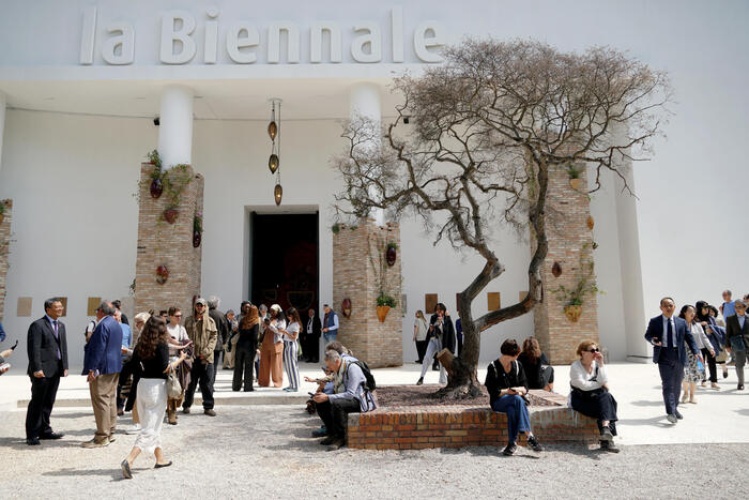
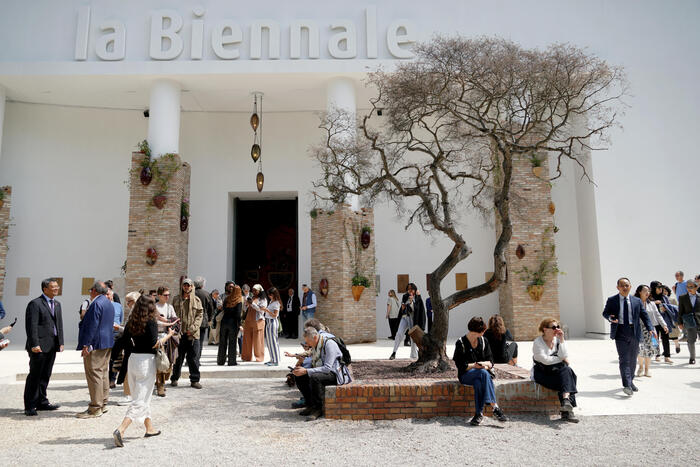
BRUSSELS – The European Commission has formally recommended that the European Education and Culture Executive Agency (EACEA) suspend its €2 million grant to the Venice Biennale, escalating the dispute over the reopening of the Russian Pavilion.
The announcement came from European Commission Executive Vice-President Henna Virkkunen, who wrote on X that the recommendation followed “a thorough assessment of the Biennale’s responses seeking to justify the reopening of the Russian Pavilion.”
“Culture in Europe, funded by taxpayers’ money, should promote and uphold democratic values,” the Finnish commissioner said. “Those values are not respected in today’s Russia.”
The Venice Biennale responded in a statement, expressing surprise that it had learned of the decision through social media rather than via the appropriate institutional channels.
“We learned on X, from political authorities rather than the competent technical authorities, of decisions concerning the European Education and Culture Executive Agency’s contribution to the Venice Biennale,” the foundation said.
The Biennale stressed that it had responded within the required timeframe to all the issues raised in EACEA’s third letter on the matter and is now awaiting a formal technical communication from the agency before assessing its next steps and defending its position through the appropriate channels.
It also noted that the programmes concerned will continue as planned, as they are only partially funded by the European grant.
The recommendation prompted an immediate backlash from Veneto Regional President Luca Zaia, who described the move as “unacceptable.”
“The EU wants to withdraw the €2 million allocated to the Venice Biennale in retaliation for the presence of Russian artists,” Zaia wrote on X. “Culture must not be censored, and artists are not soldiers. My full support goes to Buttafuoco. The Italian government must defend the Biennale.”
Veneto Deputy President Alberto Stefani echoed those concerns, arguing that culture has always served as a space for dialogue, even during history’s darkest moments, and “should never be subject to blackmail or censorship.”
He warned that the decision risks establishing the principle that cultural activity requires official approval, “and even more dangerously, that such approval can be granted by a body that is not directly elected by citizens.”
Italy’s Undersecretary for Culture Lucia Borgonzoni also condemned the Commission’s recommendation, calling it “simply unacceptable.”
“What is happening in the Biennale case is deeply troubling,” she said. “A political body, the European Union, is recommending that a technical agency, EACEA, suspend funding before any concrete evidence has been presented to justify such a decision. This represents the end of the rule of law—a purely political judgment that harms an institution which has been carrying out extraordinary work in Venice for years. Italy and its cultural institutions are free and democratic, and there is no room for economic blackmail from Brussels.”