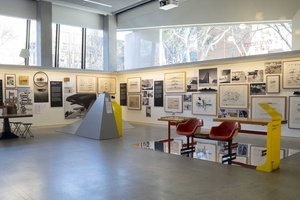
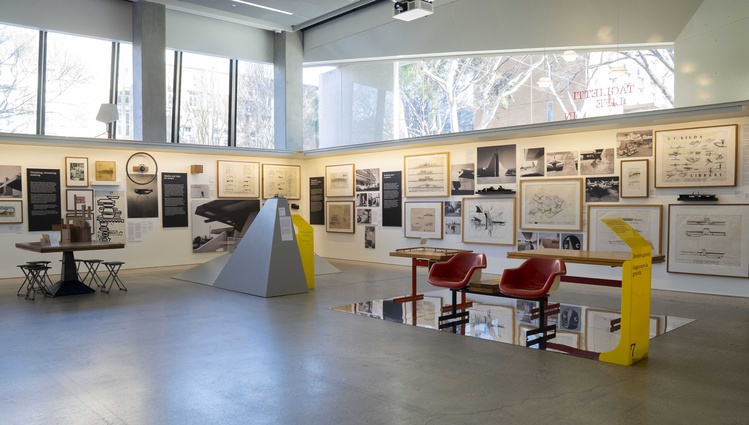
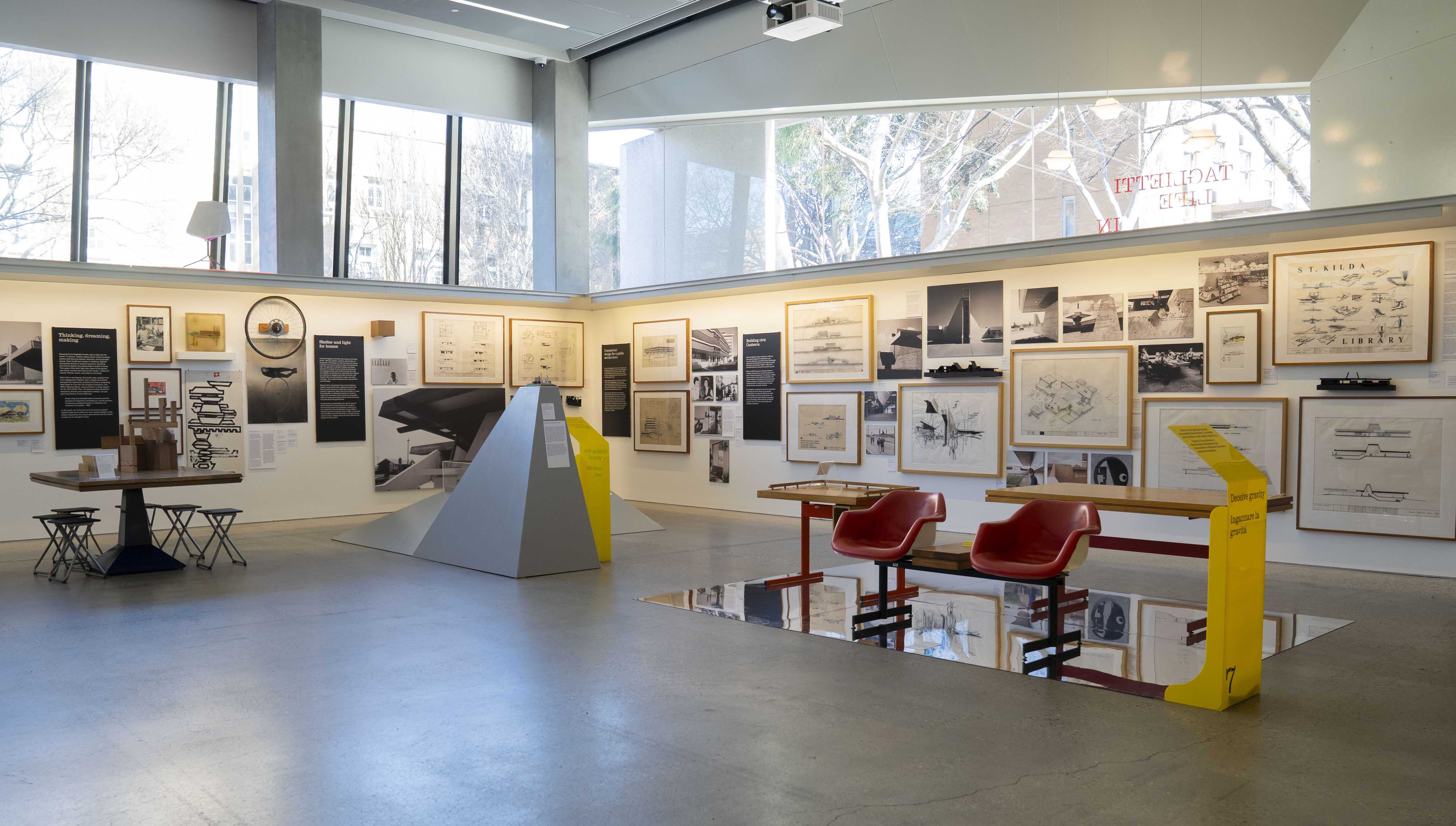
MELBOURNE – Taglietti: Life in Design is on display at the Design Gallery in the University of Melbourne’s Glyn Davis Building in Parkville until 28 August.
The exhibition marks the centenary of the birth of Enrico Taglietti, the Italian-born designer who spent much of his life in Australia, where he made a distinctive and significant contribution to the development of modern Australian architecture.
It traces his work, influences and deeply personal approach to architecture. Philip Goad, Professor of Architecture at the University of Melbourne and curator of the exhibition, which was originally developed for the Canberra Museum and Gallery, explains why Taglietti’s legacy remains so important.
When the opportunity arose to bring the exhibition to Melbourne, Goad says he immediately embraced it.
“I was very excited because Taglietti was a great Italian designer who migrated to Australia, and the St Kilda Library, which he designed, has also recently been added to the Victorian Heritage Register.”
The centenary makes the exhibition particularly timely, but Goad believes Taglietti also deserves attention because his story was very different from that of many Italians who arrived during the major waves of migration in the 1950s and 1960s.
“He wasn’t an economic migrant like many others who came during that period,” Goad explains. “He arrived almost as a cultural ambassador.”
It is a description that neatly captures the role of a designer educated at the Politecnico di Milano who brought to Australia an approach to design deeply rooted in postwar Italian culture.
Taglietti’s interests extended far beyond buildings, Goad points out. Instead, he embodied the Italian concept of design stretching “from the spoon to the city”: architecture, interiors, furniture, lighting, textiles and objects all belonged to the same creative universe.
“He had that extraordinary completeness that came from his Milanese education,” Goad says.
“Many of the great Italian designers of the 1950s and ’60s weren’t just designing houses,” but furniture and objects as well. “Taglietti had that same ambition.”
The exhibition seeks to capture the many dimensions of this multifaceted architect, bringing together more than 100 drawings, photographs and documents that trace both his professional and personal journey.
They are accompanied by furniture, lamps and archival objects, including diaries, correspondence and even his graduation cap from the Politecnico di Milano. Among the exhibits is also a fabric featuring Lucio Fontana’s famous slashes, later transformed into a dress by Taglietti’s wife, Franca.
The connection with Fontana was no coincidence. Taglietti moved within a cultural world that extended well beyond architecture, one in constant dialogue with art, design and experimentation. His education was shaped by the Milan of the Triennale and by a network of friendships and creative influences that crossed disciplines. After moving to Australia, he continued to build relationships with artists and designers.
Goad points, among others, to sculptor Clement Meadmore, whom Taglietti commissioned to create a sculptural element for Canberra’s Town House Motel, one of Meadmore’s earliest public works.
The exhibition also explores Taglietti’s relationship with David Jones, which proved instrumental in bringing him to Australia. It was an exhibition organised by the department store that first brought him to the country in 1955.
“I think a lot of people will be surprised to see just how strong Australia’s interest in Italy already was by the mid-1950s,” Goad observes.
At the heart of the exhibition is, inevitably, Taglietti’s relationship with the Australian landscape. The architect developed an unusual sensitivity to the power of the environment, expressed through the mass of his buildings, the weight of their walls, broad roof overhangs and the interplay between shade, light and landscape.
That sensitivity may also have been shaped by Taglietti’s childhood in the 1930s, when he lived with his family in Eritrea and Ethiopia, where his father had business interests.
The exhibition includes a photograph taken in Africa.
“You look at it and immediately think it could be Australia’s Top End,” Goad says. “I think that experience gave him a particular empathy for certain Australian landscapes.”
St Kilda Library remains one of the clearest examples of his approach. Taglietti conceived it as a community space.
“He created an open plan, but he also included small, intimate areas for reading. At the entrance, he designed a space with a fountain. He imagined the library as a meeting place.”
The original design also included a second stage featuring a café and gallery, reflecting what was, for the time, a remarkably forward-thinking understanding of the social role of public buildings.
According to Goad, one of Taglietti’s most innovative qualities was his ability to give architectural significance to even relatively modest buildings.
“He saw every building as an opportunity to create something special and unusual,” he says, drawing a parallel between Taglietti’s approach and the sculptural sensibility of major Italian architects such as Carlo Scarpa.
It is perhaps no coincidence that Taglietti also designed numerous schools, spaces where play and discovery took on a particularly important role.
The exhibition seeks to convey this aspect of his work through an interactive installation: visitors can sit around a table similar to one Enrico and Franca had in their Canberra apartment and use wooden blocks to freely create their own forms.
“He was interested in play, in that ability children have to find pleasure in creativity,” Goad explains.
Compared with the Canberra exhibition, the Parkville presentation introduces several new elements, including furniture from St Kilda Library and a digital component.
After Melbourne, some of the photographic material will continue its journey to Milan, where it will be exhibited at the Politecnico, symbolically closing the circle between the city where Taglietti was educated and the country where he built his career.
For Goad, whose research specialises in postwar Australian architecture, the exhibition is also an opportunity to recognise the contribution of a figure who succeeded in bringing together two design cultures without sacrificing his own identity.
Taglietti arrived from Italy with a sophisticated, multidisciplinary vision of design. Australia, in turn, offered him a landscape and a society in which to experiment. From that encounter emerged a unique architectural language – one that still has the power to surprise today.