

In our last travel article, Il Globo looked at how Australians search for holidays in Italy, and found Italy still tops Australian searches for European travel even as winter interest cools. This time we turned the question around. Where do Italians want to go when they leave home, and when do they start looking?
Google Trends data for Italy, filtered to travel searches, gives a clear answer. Italians look close to home for summer, far away for winter, and Australia sits in its own category: a small but steady draw at any time of year.
Greece tops the list
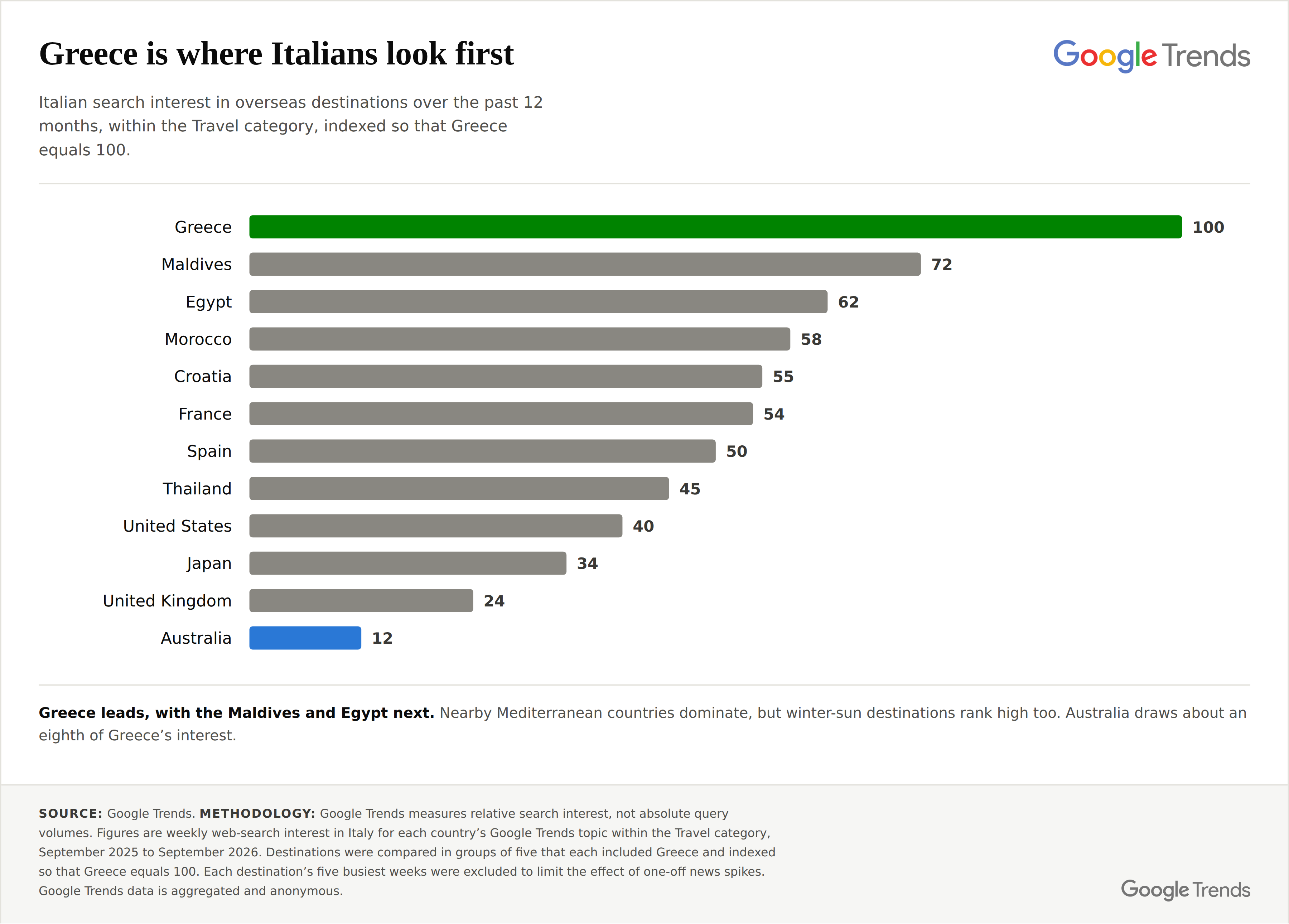
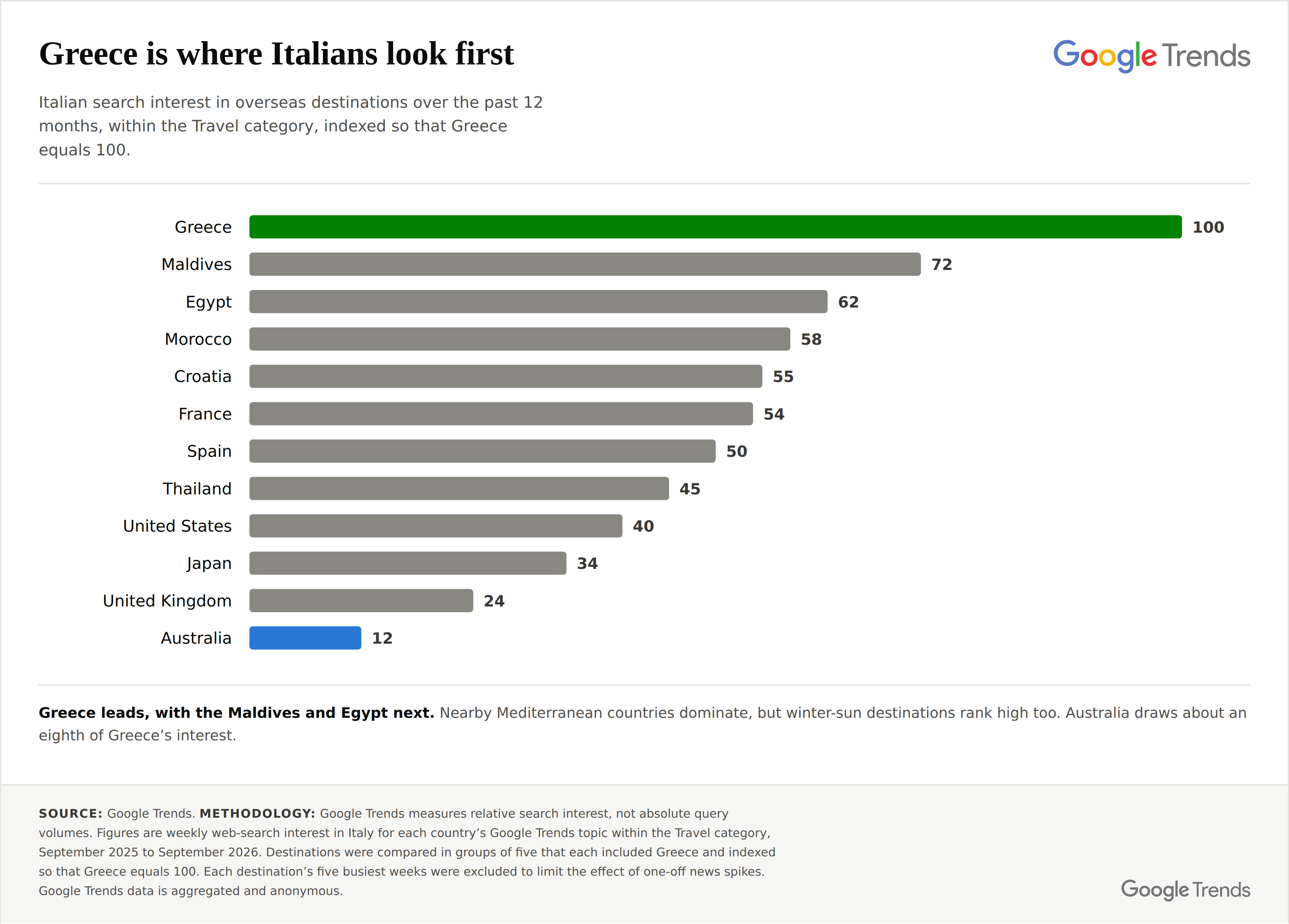
Over the past 12 months, Greece was the overseas destination Italians searched for most. The Maldives came second, followed by Egypt, Morocco and Croatia, with France and Spain close behind.
Search interest is not the same as trips taken. Italy’s national statistics office, Istat, found that Spain and France were the most visited foreign countries in 2023, accounting for 13.4 and 10.7 per cent of Italians’ trips abroad. Egypt, at 4.3 per cent, was the most visited country outside Europe. A 2025 Europ Assistance and Ipsos survey also put Spain first for summer plans, ahead of France and Greece.
Searches capture planning rather than bookings, and Greece’s island-hopping holidays appear to generate a lot of research. Most Italian travel is also within Italy itself: Istat found that about one in five trips in 2023 went abroad.
Summer close by, winter far away
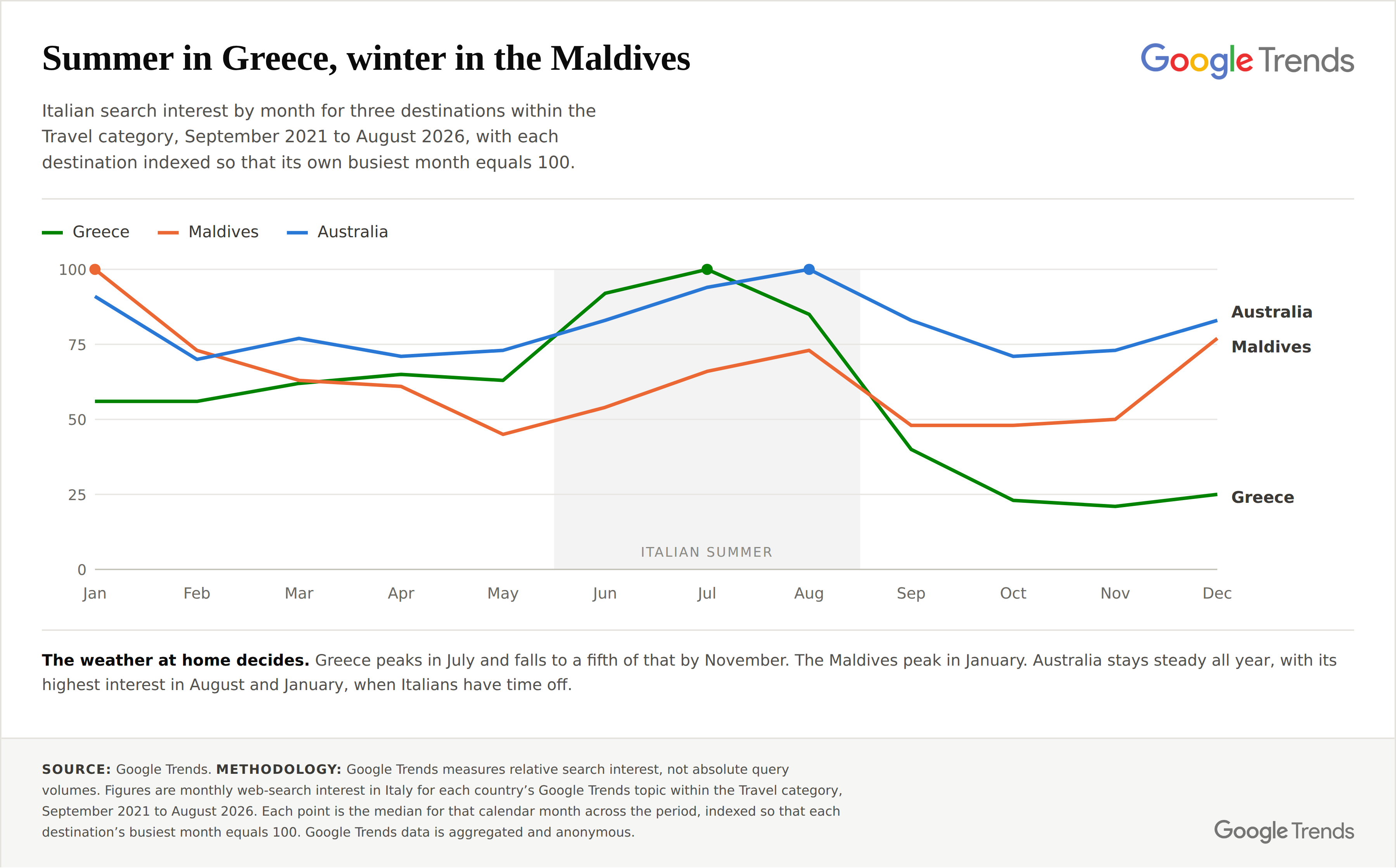
The biggest story in the data is seasonality. Searches for Greece and Croatia rise through spring, peak in July and then collapse after the summer. By November, interest in Greece is about a fifth of its July level, and Croatia falls even further.
The Maldives run on the opposite calendar. Searches peak in January, when Italians escape the northern winter, and are lowest in May. Thailand follows a similar pattern, with a second bump in August, the traditional month of Italian holidays.
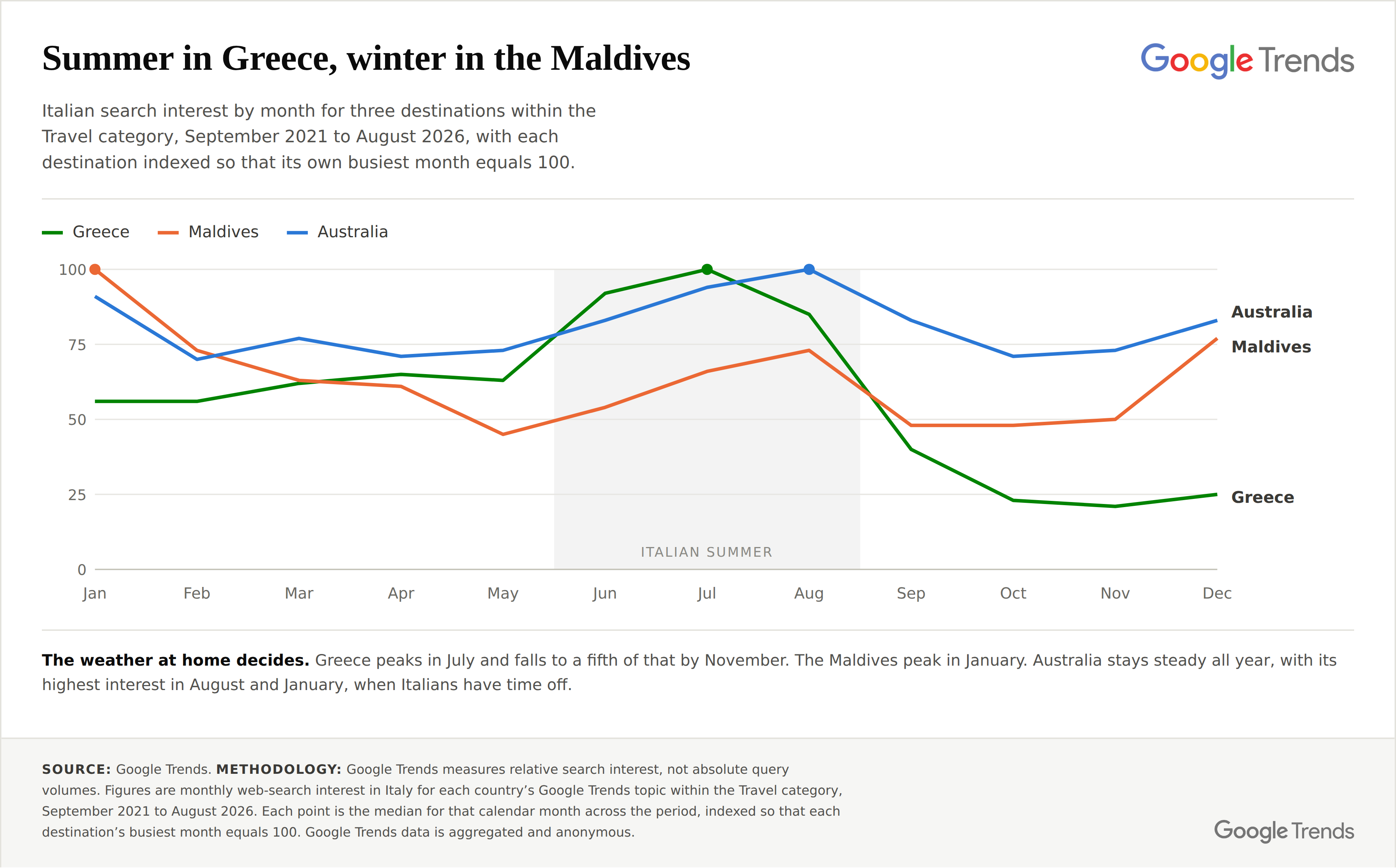
Egypt and Japan draw interest all year round. Egypt’s Red Sea resorts suit both a winter break and a summer holiday, while Japan’s searches peak around the New Year, spring and August.
Australia: small, steady and far away
Australia is a long way from Italy, and it shows. Italians’ search interest in Australia as a travel destination is about an eighth of their interest in Greece, slightly ahead of New Zealand.
But Australia is unusually steady. Its searches barely dip at any point in the year, with the highest interest in August and January, when Italians have the most time off. That fits a long-haul trip that has to be planned around holidays rather than weather.
The visitors who do make the journey stay a long time. According to Tourism Australia, 76,872 people arrived from Italy in 2025, up 17 per cent and above pre-pandemic levels. Italian holiday visitors stay an average of 33 days, 18 days longer than the average international visitor. Working holiday visa grants for young Italians have also reached record levels, with more than 10,000 in 2024–25.
Japan and Egypt are rising
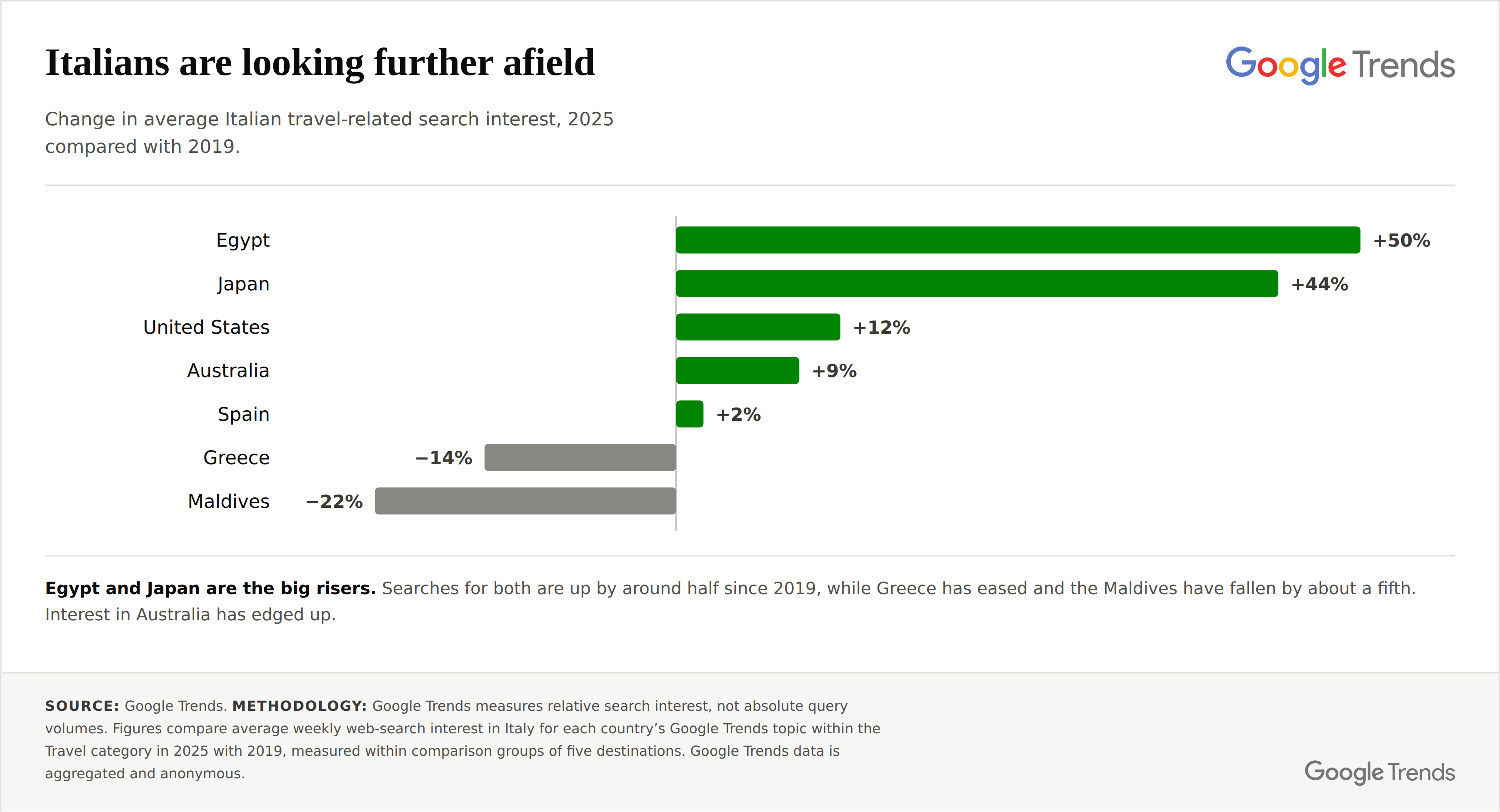
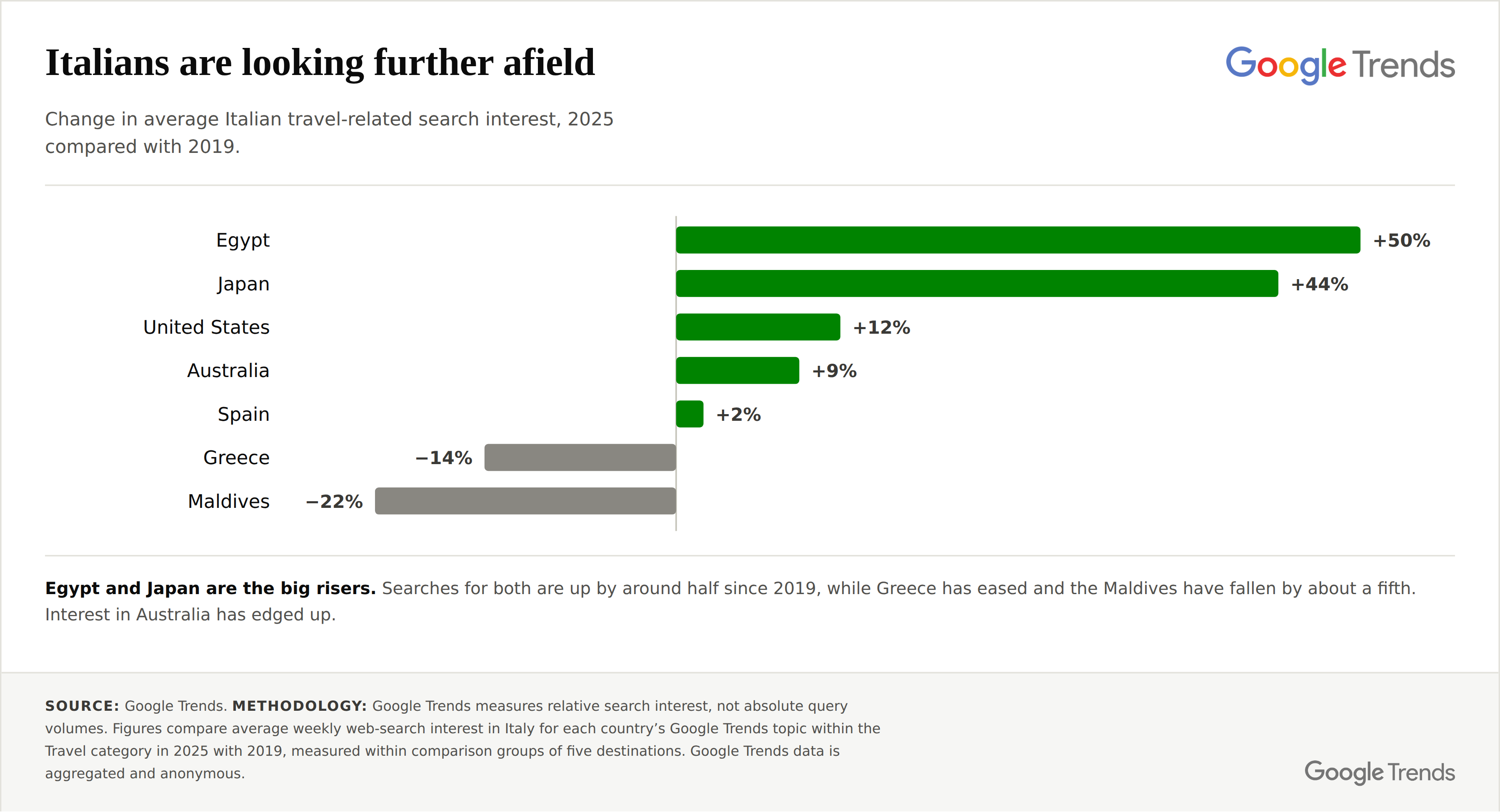
Compared with 2019, Italians’ travel searches have shifted towards more distant and warmer destinations. Searches for Egypt were about 50 per cent higher in 2025 than in 2019, and searches for Japan about 44 per cent higher. Interest in the United States and Australia has edged up.
Greece is still the top pick, but its searches have eased by about 14 per cent since 2019, and interest in the Maldives has fallen by about a fifth. Albania, one of Europe’s most talked-about new summer destinations, doubled its Italian searches between 2019 and 2024 before falling back in 2025.
Two hemispheres, one habit
Put the two sets of data together and a pattern emerges. Australians search for Italy most in their own winter, dreaming of a European summer. Italians search for Greece and Croatia in their summer, and for the Maldives when their winter arrives. On both sides of the world, the weather at home decides where people want to go.
About the data
Figures are from Google Trends for Italy, filtered to the Travel category, and were collected on 22 September 2026. Destinations are measured as Google Trends topics, which group searches in any language. Google Trends measures relative search interest on a 0–100 scale rather than absolute search volumes. For the destination ranking, destinations were compared in groups of five that each included Greece, then indexed so that Greece equals 100; each destination’s five busiest weeks were excluded to limit the effect of one-off news spikes. Seasonal patterns use the median of each calendar month from September 2021 to August 2026. Trip figures are from Istat, Europ Assistance and Ipsos, and Tourism Australia. Google Trends data is aggregated and anonymous.